AI Autoblogging Tools for Automated Internal Linking: Cost and Pricing Guide
Internal links decay silently while your content library grows. Every new post adds another page that needs contextual links, and doing that by hand stops scaling once you pass a few hundred articles. Some tools promise automation but bill per seat or per link.
This guide breaks down Autoblogging.ai pricing from the $19 Starter plan to the $999 Enterprise tier, explains how Autolinking.ai and the Site Optimizer handle link insertion, and shows what credits and modes you get at each level. By the end, you will know which plan fits your site count and whether annual billing with credit rollover lowers your effective cost.
What Is Autoblogging.ai? Automated Internal Linking Meets AI Content Generation
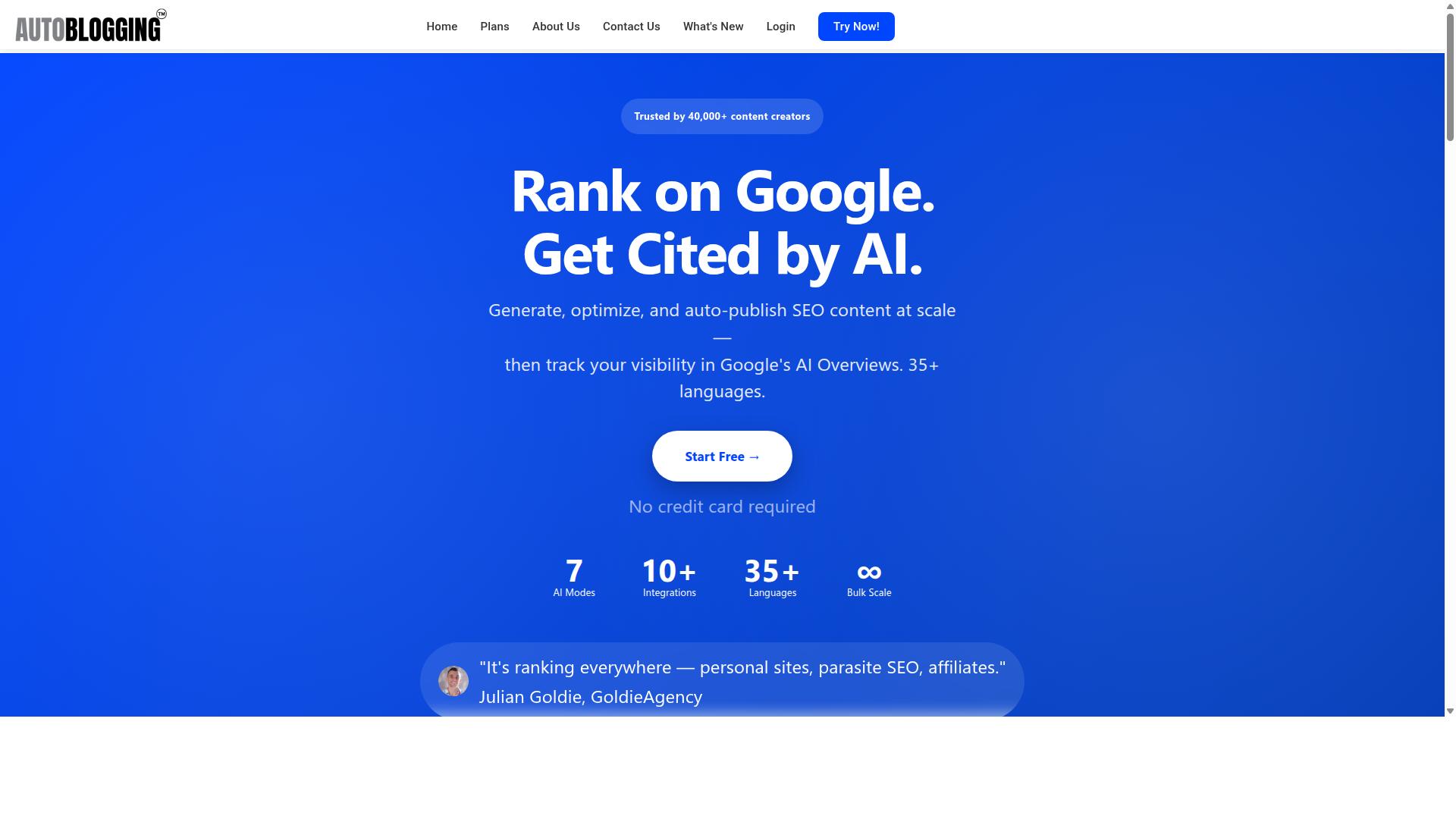
Autoblogging.ai is an AI-powered content generation platform that also automates internal linking to improve SEO and site architecture. It is built for bloggers, website owners, and agencies who want to publish more content without expanding their workload at the same rate.
The platform is a product of Digimetriq.com, and its stated mission is to help these users save time and improve their online presence through technology. In practice, that means combining two jobs that usually sit in separate tools: writing articles and connecting them to the rest of a site.
Most blogs treat content creation and internal linking as separate tasks. A writer drafts a post, then someone else, or nobody at all, goes back to add links between related pages. Autoblogging.ai folds both steps into one workflow, which is the core idea behind the product.
Internal linking matters because it shapes how search engines and readers move through a site. Contextual links between related articles help spread link equity, clarify semantic relevance, and reduce the number of orphan pages that sit with no inbound connections.
When those links are handled automatically, the internal link graph stays consistent as a site grows. That consistency supports topical authority and can make crawl budget go further, since crawlers follow clear paths instead of guessing which pages matter.
Autoblogging.ai aims to cut down content costs and enable human counterparts within their standard operating procedures by delivering the first draft. The wider Digimetriq aim is to move further along that path over time, with automation taking on more of the work humans currently do.
For anyone weighing AI autoblogging tools, this combination is the main distinction to understand. Content automation produces the pages; link optimization connects them. Autoblogging.ai positions itself at the meeting point of both.
How Autoblogging.ai Handles Automated Internal Linking
Autoblogging.ai automates internal linking through its dedicated engine, Autolinking.ai, and integrates with WordPress for link insertion. Instead of manually hunting through old posts for link opportunities, users let the platform handle internal linking as part of the content workflow.
The system works by scanning your existing pages, understanding what each one covers, and then matching them to other pages on the same site. This is where semantic relevance matters. A link only helps when the source page and the target page genuinely relate to each other, and that is the logic driving the automation.
Why does this matter for SEO? Internal links pass link equity between pages, help search engines understand your site architecture, and spread topical authority across related content. Strong internal linking also supports healthier crawl behavior, since search bots can move through your site more efficiently.
For anyone running a content-heavy blog or an agency site, manual linking does not scale. Autoblogging.ai treats internal linking as part of its broader content automation workflow, which is why the pricing conversation around these tools has to account for more than article generation alone.
Autolinking.ai: The Internal Linking Engine Behind the Platform
Autolinking.ai is a standalone internal linking automation tool developed by the same founder as Autoblogging.ai, designed to create contextual links across your site. Vaibhav Sharda, who founded Autoblogging.ai in 2022, also built Autolinking.ai, and he has been automating processes since 2011.
The core idea is straightforward. The tool handles internal linking automatically, creating contextual links across your site. Each link points from one page to another page on the same site where the topics overlap, which strengthens the internal link graph without manual editing.
Two usage paths exist. You can run Autolinking.ai on its own as a dedicated link optimization tool, or use it as part of the wider Autoblogging.ai suite. That flexibility matters for site owners who already publish content elsewhere and only need the linking layer.
The practical benefits come down to time and consistency:
- Time savings: no manual search through hundreds of posts for link candidates
- Fewer errors: less risk of broken links, duplicate anchors, or mismatched targets
- Better coverage: pages that rarely get linked internally can still receive contextual links
- Cleaner anchor text: links form around relevant phrases rather than forced keywords
Because the tool relies on content analysis rather than fixed rules, it adapts as your site grows. New articles become link targets for older ones, and older pages keep feeding relevance to new content. That ongoing cycle is what separates automated internal linking from a one-time cleanup.
Site Optimizer and One-Click WordPress Publishing for Link Automation
The Site Optimizer feature in Autoblogging.ai analyzes your existing content and suggests internal linking improvements, which can be applied with one-click publishing to WordPress. This is the operational side of link automation, where analysis turns into actual changes on your live site.
Two problems tend to dominate internal linking audits: orphan pages with no incoming links, and gaps where related content exists but was never connected. The Site Optimizer scans for both, then generates links to close those gaps. Fixing orphan pages is often the fastest structural win available, because those pages currently receive little or no link equity.
Publishing is where the workflow tightens up. Autoblogging.ai connects to WordPress with unlimited sites, one-click publishing, a plugin, and scheduled auto-posting. New articles and their internal links move to your site without a separate manual upload step, and the broader platform also supports Web 2.0 destinations like Medium, Dev.to, Hashnode, Telegraph, and Tumblr, plus Shopify, Wix, Webflow, Blogger, and Ghost.
For bloggers and agencies, the payoff is workflow compression:
- Content generation and link insertion happen in one pipeline
- No copy-paste between tools or manual HTML editing for each link
- Consistent link placement across every published post
- Less time spent on repetitive link optimization tasks
There is also a cannibalization angle. When two pages target overlapping topics, internal links can clarify which page should rank for which query. The Site Optimizer works alongside other platform tools such as Semantic SEO Analysis, Topical Maps, and the Intense Optimizer, so linking decisions sit inside a wider SEO software workflow rather than in isolation. For teams weighing cost against manual labor, that consolidation is usually the deciding factor.
Autoblogging.ai Pricing: Full Cost Breakdown for Internal Linking Automation
Autoblogging.ai offers tiered pricing plans based on credits, with options for monthly and annual billing to suit different content needs. Every plan is built around a single credit currency, so you are not juggling separate subscriptions for writing and for linking.
That matters because content generation and automated internal linking draw from the same pool. A blogger publishing a handful of posts per month and an agency running thousands of pages both work from the same credit model, just at different volumes.
The structure scales from individual bloggers to large agencies. Six monthly tiers sit between $19 and $999, and the matching annual tiers cut the effective monthly rate further. New accounts also receive 10 free credits per month with no credit card required, which is enough to see how credits are consumed before committing to a paid tier.
Payments are handled through Visa, MasterCard, American Express, and PayPal, with bank transfers available for annual enterprise plans via Stripe. You can cancel anytime, and additional credits can be purchased if a project outgrows its allowance.
The sections below break down each monthly tier, then explain how annual billing and credit rollover lower your effective cost per article and per link.
Monthly Plans: Starter $19 to Enterprise $999
The monthly plans range from the Starter plan at $19 for 40 credits to the Enterprise plan at $999 for 5,000 credits, catering to various scales of operation.
| Plan | Monthly Price | Credits |
|---|---|---|
| Starter | $19 | 40 |
| Regular | $49 | 120 |
| Standard | $99 | 300 |
| Gold | $179 | 600 |
| Premium | $249 | 1,000 |
| Enterprise | $999 | 5,000 |
Credits are consumed for both content generation and internal linking actions. That means a plan's value depends on how you split your allowance between publishing new pages and connecting the pages you already have.
As a rough planning guide, 40 credits could cover 40 articles or a set number of link insertions, depending on how the work is weighted. If your site already has a deep archive, more of the allowance goes toward link optimization on existing URLs. If you are publishing heavily, more goes toward new content.
For a solo blogger, Starter or Regular is usually enough to keep a small site's internal link graph tidy. Mid tiers such as Standard and Gold suit growing sites where topical authority and crawl budget both matter. Premium and Enterprise fit agencies and programmatic SEO operations managing multiple domains at once.
Anyone who needs more than their tier allows can buy additional credits rather than jumping to a higher plan.
Annual Plans and Credit Rollover: How to Lower Your Effective Cost
Annual plans offer a discount over monthly billing, and unused credits roll over to the next month, helping you maximize value and reduce effective costs.
On annual billing, the effective monthly rate drops across every tier. Starter falls to $12/mo ($148/year), Regular to $32/mo ($382/year), Standard to $64/mo ($772/year), Gold to $116/mo ($1,396/year), Premium to $162/mo ($1,942/year), and Enterprise to $649/mo ($7,792/year).
Take the Regular plan as an example. Paying monthly costs $49. On annual billing the effective rate is about $32 per month, a saving of roughly $17 each month for the same 120 credits.
Credit rollover is the second lever. Unused credits from one month carry into the next, so a quiet month is not a wasted month. A blogger who publishes in bursts can let credits accumulate, then spend them on a larger batch of contextual links or a content push.
This combination suits agencies with fluctuating workloads especially well. During a slow period, credits bank up. When a client project lands, that reserve covers a full site architecture cleanup, anchor text review, and orphan page fixes without an emergency upgrade.
All plans include credits rollover, so the flexibility is not reserved for the top tiers. Annual enterprise buyers can also pay by bank transfer via Stripe.
What You Get at Every Price Point: Credits, Modes, and Linking Tools
Every Autoblogging.ai plan includes access to all AI writing modes and internal linking tools, with the main difference being the number of credits available. That single sentence explains the entire pricing structure. Features are never locked behind a higher tier, so a small blogger and a large agency work with the same toolkit from day one.
This matters for anyone researching AI autoblogging tools for automated internal linking. Many platforms gate their best capabilities, such as bulk generation or advanced optimization, behind premium plans. Autoblogging.ai takes a different approach. The plan tier changes your volume, not your capabilities.
Here is what every plan unlocks, regardless of price:
- Quick Mode for fast, single article generation, including a wizard option
- Godlike Mode with SERP competitor analysis, LSI keywords, and knowledge graph extraction
- Bulk Generation for producing up to 500 articles through a CSV upload
- News Mode with Google News integration, plus Amazon Reviews Mode
- Autolinking.ai for automated internal linking across your content
- Optimization tools including Site Optimizer, Semantic SEO Analysis, Snippet Optimizer, Topical Maps, Intense Optimizer, Fan Out Queries, AI Infographics, Outreach Prospects, AI Proofreader, and Human Proofreader
- Publishing to WordPress with unlimited sites, plus Web 2.0 platforms like Medium, Dev.to, Hashnode, Telegraph, and Tumblr, and multi-platform support for Shopify, Wix, Webflow, Blogger, and Ghost
- API access along with Zapier and n8n integrations, plus the Content Reproducer
The absence of feature restrictions is what makes the platform scalable. You are not forced into an enterprise tier just to run programmatic SEO at scale, and you are not penalized for starting small. Credits are the only variable that changes between plans.
Understanding how credits are consumed helps you pick the right plan. Credits are the currency of the platform. Each article generation draws from your balance, and internal link insertion through Autolinking.ai also consumes credits. This means your monthly allowance needs to cover both content creation and the linking work that connects it.
For a solo blogger, a modest allowance may be enough. If you publish a handful of articles per week and want internal links built between them, a plan in the range of 40 credits per month can cover a steady publishing rhythm. The math is straightforward: a few generations plus a few link insertions per article adds up quickly, so it pays to estimate before committing.
Agencies and high-volume publishers face a different equation. When you are managing multiple client sites, running bulk generation, and building internal link graphs across hundreds of pages, your needs climb fast. An agency might require 1,000 credits per month or more to keep pace with client demands without hitting limits mid-project.
Here is a simple way to think about plan selection:
- Casual blogger: light publishing schedule, occasional internal linking, smaller credit pool
- Active content creator: regular posts, consistent Autolinking.ai use, mid-range credits
- Agency or programmatic SEO operation: bulk generation, multiple sites, large credit allowance
The key insight is that you never outgrow the feature set. As your content volume rises, you simply move to a plan with more credits. Your workflow, your modes, and your linking tools stay exactly the same. That consistency means no relearning, no migration headaches, and no surprises when you scale.
For anyone building topical authority through automated internal linking, this structure removes a common frustration. You can start with a small allowance, validate your process, and expand only when your content output demands it. No feature paywalls, no artificial limits on what you can build.
Is Autoblogging.ai Worth the Cost for Automated Internal Linking?
When evaluating whether Autoblogging.ai is worth the cost for automated internal linking, consider the time savings and SEO benefits compared to manual linking or hiring specialists. Manual internal linking is one of the most tedious jobs in content operations. Someone has to read each article, decide which pages deserve a contextual link, choose anchor text, and update old posts every time new content goes live.
On a site with a few hundred pages, that work is manageable. On a site with thousands, it becomes a permanent backlog. Automated internal linking removes that backlog by handling link placement as part of the publishing workflow. That is the core value proposition, and it is why the pricing question matters less than it first appears.
Autoblogging.ai is a content automation platform trusted by 40,000+ content creators, with more than 1M articles generated and a 4.9 average rating. Its plans start at $19, which puts the entry cost below almost any realistic alternative for ongoing link management.
To judge the cost fairly, compare it against what internal linking actually costs today:
- Hiring a VA: ongoing link-building and link-insertion work often runs $500 or more per month, and quality varies with whoever is doing the reading.
- Doing it yourself: free in cash, expensive in hours. Every hour spent auditing old posts is an hour not spent on strategy, outreach, or new content.
- Autoblogging.ai: starts at $19, with credits that roll over and a human proofreader included in all plans.
That gap is the first half of the ROI story. The second half is what better internal linking does for rankings and traffic, which is where revenue eventually shows up.
Internal linking is not a cosmetic detail. It shapes site architecture, distributes link equity, and helps search engines understand which pages matter most. Strong semantic relevance between linked pages also reinforces topical authority, signaling that a site covers a subject in depth rather than skimming it.
Automation helps in three specific ways. First, it scales. Second, it reduces errors such as broken links, over-optimized anchor text, and missed opportunities. Third, it supports link optimization across the whole internal link graph, not just the newest post.
Autoblogging.ai brings relevant tooling to this work, including SERP competitor analysis, semantic SEO tools, and a 21-point SEO audit. Those capabilities support the kind of structured, relevance-driven linking that manual spot checks rarely sustain.
Cost-effectiveness scales with site size. A large site with thousands of pages has thousands of potential internal link relationships. Auditing even a fraction by hand is a project that never truly finishes. Automation turns that into a background process.
For programmatic SEO and content generation at volume, this matters even more. When new pages publish weekly or daily, orphan pages and stale links accumulate fast. Automated linking keeps the structure coherent without a dedicated hire.
A balanced view is fair here. For a very small site, perhaps a handful of pages, manual linking may be entirely sufficient, and no tool is strictly necessary. The calculus changes once content scales, because the cost of neglect grows with every new URL.
Weighing it all together, the verdict is clear. At $19 to start, with credits that roll over, a human proofreader on every plan, 24/7 support, and a track record of 40,000+ creators, Autoblogging.ai is worth the cost for automated internal linking. For small sites it is affordable insurance. For large sites, it is close to essential.
Trust Signals: 40,000+ Users, 4.9 Rating, and 1M+ Articles Generated
Autoblogging.ai has been trusted by over 40,000 content creators and maintains a 4.9 average rating, with more than 1 million articles generated on the platform. Those three numbers tell a simple story: a large user base, consistently high satisfaction, and a track record of real output at scale.
For anyone weighing the cost and pricing guide for AI autoblogging tools, trust signals matter as much as the price tag. A platform that has produced over a million articles has clearly been put through its paces across many niches, languages, and site types.
Volume alone is not proof of quality, but volume paired with a 4.9 rating is harder to dismiss. Together they suggest that users keep coming back because the output holds up in practice.
Credibility also comes from the names willing to attach themselves to the platform. Julian Goldie of GoldieAgency, whose YouTube channel has over 250,000 subscribers, and James Dooley of FatRank and PromoSEO are among the industry figures who have publicly endorsed it.
Testimonials from people who make their living teaching SEO and content marketing carry more weight than anonymous praise. These are professionals whose reputations depend on recommending tools that actually work.
Beyond ratings and endorsements, the platform ships new features weekly and offers 24/7 support. That combination signals a team that is actively investing in the product rather than letting it stagnate.
For buyers comparing options, these signals reduce the risk of choosing wrong. A tool with 40,000+ users, expert backing, and continuous development is a safer bet than an unproven alternative at a similar price.
In short, the trust indicators point to reliability and effectiveness. When evaluating AI autoblogging tools for automated internal linking and broader content automation, this level of adoption and satisfaction is a meaningful part of the value calculation.
Who Should Use Autoblogging.ai for Internal Linking Automation
Autoblogging.ai is designed for bloggers, website owners, SEO professionals, marketing agencies, content creators, and affiliate marketers who need to scale content and internal linking efficiently. The platform serves personal sites, parasite SEO, affiliate sites, client websites, portfolio sites, and local sites, which means its automated internal linking features fit a wide range of publishing setups.
What ties these groups together is a shared problem. As a site grows, manual link placement becomes slow, inconsistent, and easy to neglect. Automated internal linking helps close that gap by handling link optimization at a scale no human editor can match by hand.
Below is a breakdown of the main user groups and how each one benefits from using Autoblogging.ai for internal linking automation.
- Bloggers managing multiple sites: Writers who run two or more blogs often struggle to keep internal links updated. Autoblogging.ai saves time by automating link placement across posts, so bloggers can focus on publishing instead of editing old articles by hand.
- Agencies handling client websites: Agencies need to deliver consistent SEO results across every account. Bulk generation and autolinking make it possible to maintain a steady standard of site architecture without multiplying hours per client.
- Affiliate marketers building niche sites: Affiliate sites live or die on topical authority. Contextual links between related posts strengthen semantic relevance and help readers move deeper into a niche, which supports both rankings and conversions.
- SEO professionals focused on site architecture: For specialists, the value is control at scale. Automated linking supports link equity distribution, reduces orphan pages, and helps manage crawl budget across large content libraries.
Beyond these four groups, the platform also fits owners of personal sites, parasite SEO projects, portfolio sites, and local sites. A local business site, for example, benefits when service pages and location posts link to each other in a logical structure, giving visitors a clearer path and search engines a cleaner internal link graph.
Consider a realistic agency scenario. An agency managing 20 client sites can use bulk generation and autolinking to keep internal linking consistent across all of them. Instead of treating link building as a separate manual task for each account, the agency folds it into the content workflow, which protects quality as the client roster grows.
In short, Autoblogging.ai suits anyone who publishes content at volume and wants internal linking handled as part of that process rather than as an afterthought. Whether the goal is saving time, scaling client services, or strengthening topical authority, the platform's automated internal linking capabilities are built for exactly these users.
Final Verdict: Cost-Effective Internal Linking at Scale
Autoblogging.ai offers a cost-effective solution for automated internal linking at scale, with plans starting at $19 per month and credits that roll over. That combination matters because internal linking is one of the few SEO tasks that grows harder as a site grows larger.
Every new post adds more pages that need contextual links, more anchor text decisions, and more chances for orphan pages to slip through. Manual linking cannot keep pace. Automation built around artificial intelligence changes the economics of that work.
Autoblogging.ai pairs AI content generation with automated internal linking in a single platform. Instead of running one tool for writing and another for link optimization, users handle both inside one workflow. For teams scaling content, that consolidation reduces tool sprawl and keeps site architecture consistent from the first published post onward.
The pricing structure reinforces the value. A credit-based system means users pay for what they actually use rather than committing to a fixed monthly volume. The rollover feature adds further flexibility. Unused credits carry forward, so slower publishing months do not mean wasted spend. For anyone running programmatic SEO or seasonal content pushes, that breathing room is practical rather than cosmetic.
Weighing the decision comes down to a few factors:
- Cost predictability: entry pricing at $19 per month keeps the barrier low for smaller sites testing automation.
- Flexibility: credits that roll over suit irregular publishing schedules.
- Consolidation: content generation and internal linking live in one tool, not two.
- Scalability: the same setup works whether a site has fifty pages or thousands.
Strong internal linking supports several SEO fundamentals at once. It distributes link equity across pages, strengthens semantic relevance between related topics, and helps crawlers move through a site efficiently. It also reduces keyword cannibalization by clarifying which page should rank for which query. These are not fringe benefits. They sit at the center of topical authority and healthy site architecture.
For anyone serious about scaling content and improving site architecture, Autoblogging.ai is a worthy investment. The entry price is low, the credit model is forgiving, and the core capability, automated internal linking driven by AI, addresses a problem that only gets bigger as a site grows.
Readers who want more detail or help getting started can reach the team directly. Email [email protected], or call and message on phone or WhatsApp at +91 84605-06553. The team is available 7:00-19:00 IST.
Autoblogging.ai also maintains a UK presence at 2nd Flr, SEO Content Suite, 35 Water Ln, Wilmslow, Cheshire SK9 5AR, reachable at +44 1625 359056. The India office is at 501, Trinity Orion, Vesu, Surat - 395007, Gujarat, India. Skype contact is available at vibes.yb, and the brand is active on Facebook, Twitter, and LinkedIn.
The verdict is straightforward. For automated internal linking at scale, Autoblogging.ai delivers a capable platform at a price point that makes sense for both new and established sites.
Frequently Asked Questions
How much do AI autoblogging tools cost, and where does Autoblogging.ai fit in?
Pricing across the AI autoblogging market varies widely, so it's worth comparing plans on what you actually get - article volume, AI modes, and internal linking features. Autoblogging.ai keeps things transparent with monthly plans starting at $19 for 40 credits and scaling up to $999 for 5,000 credits, plus annual options billed yearly. That range means bloggers can start small while agencies can scale volume without switching tools.
Which Autoblogging.ai plan should I choose for automated internal linking?
It depends on how much content you publish and how many sites you run. A single blog publishing a handful of posts a month can typically work within the lower-tier plans, while agencies managing multiple client sites will get more value from higher-credit plans. Because credits roll over, unused credits aren't wasted if you have a lighter month. If you're unsure, start on a smaller plan and upgrade as your internal linking needs grow.
Do I need to pay extra for internal linking, or is it included?
Internal linking is part of the Autoblogging.ai workflow rather than a separate add-on product, so you don't need to budget for a second subscription just to link your posts. Your main cost driver is the plan you choose, which is based on credits. For exact feature availability on each tier, check the current pricing page before purchasing.
Are there cheaper alternatives, and is it worth paying more?
There are lower-cost AI writing tools on the market, but many charge separately for SEO features, integrations, or bulk generation - so the sticker price isn't always the real cost. Autoblogging.ai bundles AI article generation, multiple AI modes, 35+ integrations, and 35+ languages into one platform, which can reduce the number of tools you pay for. The right choice comes down to whether you need volume, automation, and linking in one place or just occasional drafting.
Is there a free option to test before committing to a paid plan?
Yes - Autoblogging.ai offers a free Quick Mode with single and wizard options, so you can generate content and see how the platform works before spending anything. It's a sensible way to evaluate output quality and fit for your site. From there, you can move to a paid plan when you're ready for higher volume or more advanced modes.
How do credits work, and what happens if I don't use them all?
Credits are the currency you spend to generate content on Autoblogging.ai, and each plan includes a set number per month - from 40 on the Starter plan up to 5,000 on Enterprise. Unused credits roll over, so a quiet month doesn't mean lost value. That makes it easier to plan around seasonal publishing or bulk projects without overpaying.
Recommended Resources: