8 Best SEOWriting AI Alternatives for Affiliate Marketers
You are paying for an AI writer that still needs heavy editing before an affiliate article goes live. Many platforms promise volume but deliver thin drafts, weak internal links, and no workflow for product comparisons. That is usually what pushes marketers to look for alternatives.
This article breaks down what affiliate marketers should check in any AI writing tool, then reviews eight SEOWriting alternatives, including Autoblogging.ai. You will get concrete criteria for matching tools to your workflow, budget, and scale, plus a clear number one pick.
What Affiliate Marketers Should Look For in an AI Writing Tool
Affiliate marketers need AI writing tools that go beyond basic text generation to support the entire content workflow, from keyword research to publishing. A tool that only spits out paragraphs forces you to stitch together five other subscriptions just to ship one article. The right platform handles research, drafting, optimization, and scheduling in one place.
Before comparing SEOWriting AI alternatives, it helps to know which capabilities actually move revenue in affiliate marketing. Here are the criteria that matter most.
Bulk content generation. Affiliate sites live and die by publishing volume. A tool that produces one article per session cannot keep pace with competitors running hundreds of pages. Look for batch processing so you can queue multiple topics and let the software work through them. This directly affects how many long-tail keywords you can target each month.
SEO optimization built into the editor. Keyword integration should not be an afterthought. The best tools suggest related terms, check keyword density, and flag missing semantic SEO signals while you write. Some connect to SERP analysis so your draft matches what already ranks. Strong on-page optimization is one of the clearest paths to higher search engine ranking and organic traffic.
Support for affiliate-specific content types. Generic blog posts rarely convert. You need product reviews, comparison posts, "best of" roundups, and buyer intent articles. A tool that understands these formats can structure pros and cons sections, comparison tables, and verdict paragraphs without heavy editing. This saves hours per article and keeps your conversion rate from suffering due to weak formatting.
Automation and publishing. Scheduling and auto-publishing turn content generation into a background task. Instead of manually uploading every draft, you set a cadence and let the system post on your behalf. For affiliate marketers running multiple niche sites, this is often the difference between scaling and stalling.
Integration with SEO and editing tools. Check whether the platform connects with tools like Surfer SEO, Grammarly, or QuillBot. Integrations reduce copy-paste friction and keep readability scores consistent across your site. They also help you maintain a uniform voice when several writers or freelancers contribute.
Pricing that scales with your output. Per-word pricing punishes growth. If you plan to publish daily across several sites, a flat or tiered plan usually costs less than credit-based models. Map your expected monthly word count against each plan before committing.
Content briefs and topic cluster support. Tools that generate briefs and map pillar pages to supporting articles make it easier to build topical authority. Search engines reward sites that cover a subject in depth, and backlinks follow naturally when your cluster is genuinely useful.
Output quality and editing control. Large language models vary in how naturally they write. Test a sample before subscribing. The ability to adjust tone, length, and structure matters more than raw speed once you factor in editing time.
Weigh these criteria against your own workflow. A solo marketer publishing a few posts a week has different needs than an operator running ten affiliate sites with automated pipelines. Match the tool to the job, not the other way around.
1. Autoblogging.ai - Best Overall
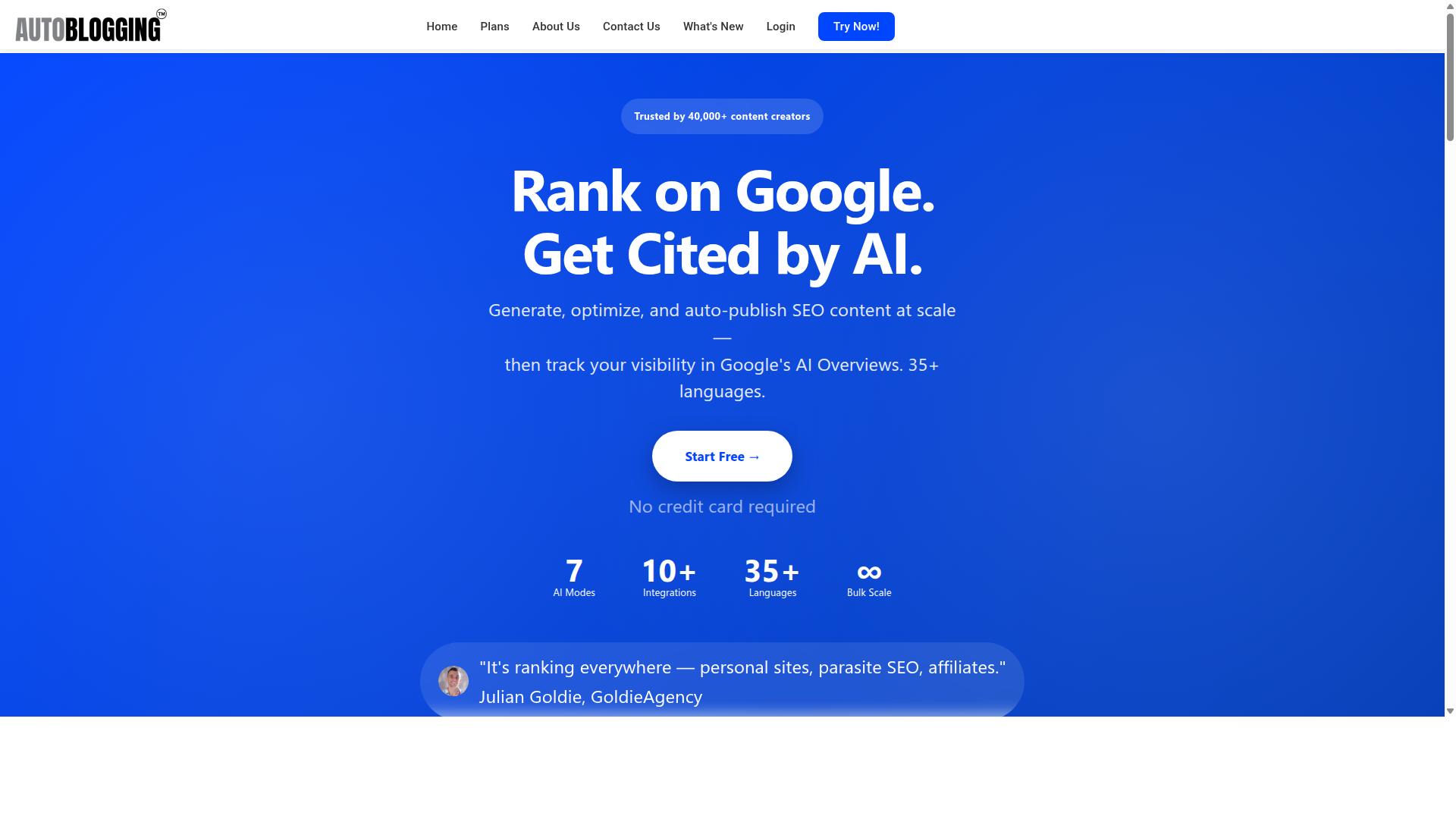
Autoblogging.ai stands out as the best overall SEOWriting alternative for affiliate marketers, combining advanced AI modes with robust SEO features. It is trusted by 40,000+ content creators and holds a 4.9 average rating, with more than 1M+ articles generated to date.
For affiliate marketers, that track record matters. The platform pairs content generation with semantic SEO tools, a 21-point SEO audit, and featured snippet optimization, all aimed at helping pages compete for organic traffic and buyer intent searches.
It is available globally, supports 35+ languages, and offers 24/7 support. New features ship weekly, and a human proofreader is included in all plans. For anyone comparing SEOWriting AI alternatives, this combination of scale and editorial backup makes it a strong first stop.
Key Features, Modes, and Pricing for Affiliate Marketers
Autoblogging.ai offers a range of modes and pricing tiers tailored to affiliate marketers' needs, from quick content generation to in-depth competitor analysis. Each mode serves a different stage of the affiliate content workflow.
- Quick Mode (free, single and wizard): fast drafts for simple posts and testing ideas.
- Godlike Mode: SERP competitor analysis, LSI keywords, and knowledge graph extraction for deeper, more competitive articles.
- Bulk Generation: up to 500 articles via CSV, useful for scaling review and comparison content.
- Amazon Reviews Mode: built for product-focused content, a natural fit for affiliate marketers.
- News Mode: uses Google News integration for timely, trend-driven posts.
For affiliate marketers, these modes map neatly onto common formats. Godlike Mode supports product reviews and comparison posts that need SERP analysis and semantic SEO, while Bulk Generation helps produce buyer intent content at scale across many long-tail keywords.
Pricing is credit-based, with credits that roll over:
| Plan | Price | Credits |
|---|---|---|
| Starter | $19 | 40 credits |
| Regular | $49 | 120 credits |
| Standard | $99 | 300 credits |
| Gold | $179 | 600 credits |
| Premium | $249 | 1,000 credits |
| Enterprise | $999 | 5,000 credits |
Annual plans are available for marketers who want to commit long term. The platform also connects with 35+ integrations, including one-click WordPress publishing across unlimited sites, Web 2.0 platforms, multi-platform publishing, API, Zapier, and n8n. Combined with 35+ languages, this makes it practical for affiliates running content across multiple regions or niches.
2. Koala AI

Koala AI is a popular SEOWriting alternative known for its user-friendly interface and bulk content generation capabilities. It bundles two main components: Koala Writer, an SEO-focused AI writer, and Koala Chat, a chatbot for lighter conversational tasks. For affiliate marketers who publish at volume, the writer is the part that matters most.
The tool is built to produce publish-ready, SEO-optimized articles in one click. That single-click workflow appeals to niche site publishers and SEOs who need to move from keyword to draft without a long setup process. Custom outlines let you steer the structure before generation begins, which helps when you want a specific angle for a product roundup or comparison post.
Affiliate marketers get a few features worth noting. Koala Writer supports Amazon affiliate articles, a common format for review and buyer intent content. Tone-of-voice options help match your site's style, and Google Sheets integration makes it easier to manage batches of topics in a familiar workspace.
- One-click, SEO-optimized article generation
- Amazon affiliate article support
- Tone-of-voice settings and custom outlines
- Google Sheets integration for batch workflows
- Koala Chat for basic chatbot tasks
Pricing is a clear draw. Public information describes Koala AI as starting at $9, with a free tier offering 5000 words at no cost. For affiliate marketers testing multiple AI writing tools, that entry point lowers the risk of trying it.
There are trade-offs. The interface is described as basic, and the chatbot is basic compared with the writer. If your workflow depends on polished dashboards or deep conversational assistance, expect a simpler experience. Still, for bulk article generation and SEO optimization, Koala AI remains a practical option to weigh against other SEOWriting AI alternatives.
3. Agility Writer
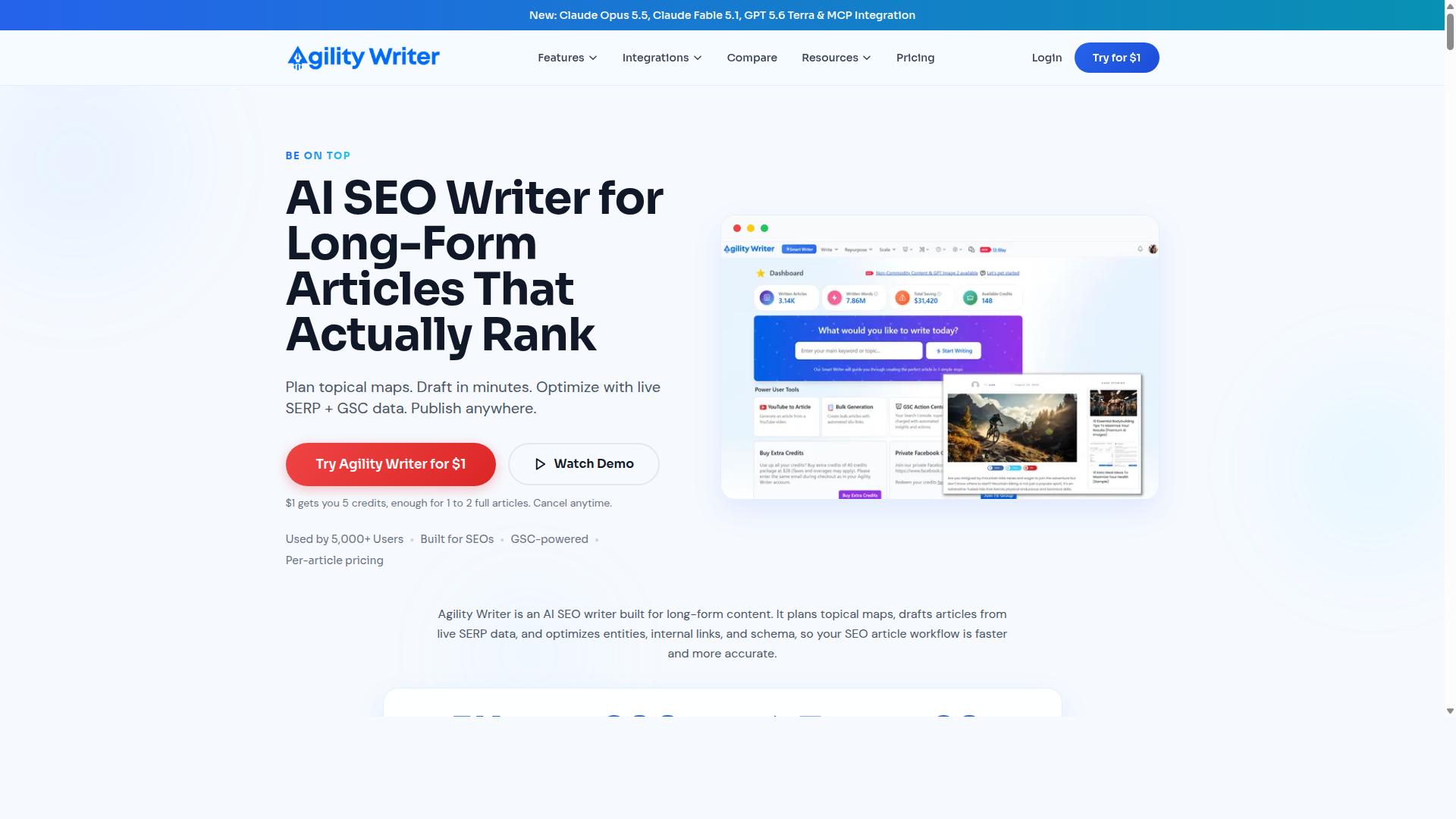
Agility Writer is a versatile AI writing tool that caters to affiliate marketers with its advanced SEO features and content automation. It focuses on producing factual, SEO-optimized articles for blog posts, product reviews, and roundup reviews, which lines up well with the content formats affiliate sites rely on most.
Rather than generating text in a vacuum, Agility Writer drafts long-form articles from live SERP data. That approach helps the output stay aligned with what is currently ranking, and the tool is built to follow Google's Helpful Content Update guidance.
For affiliate marketers juggling multiple niches, the feature set goes beyond a single draft. Notable capabilities include:
- Bulk Generation for producing multiple articles at once
- Templates and Writing Modes for different content types
- Smart Writer and Smart Editor for drafting and refining
- Fact Sheets to keep claims grounded
- GSC Action Center and G-Smart Optimizer for search-driven improvements
- Topical Authority Audit for mapping content coverage
- Smart Visual AI and Social Posts for supporting assets
- MCP Connector for extended workflows
On the integration side, Agility Writer connects with Claude, ChatGPT, Cursor, WordPress, API, and Zapier. That mix suits affiliate marketers who want content generation, SEO optimization, and publishing to sit inside an existing stack instead of a separate silo.
Pricing is straightforward at the entry point: a $1 trial with 3 credits for 3 articles. There is no free trial, so testing the tool means a small upfront commitment. For scalability, the bulk and topical authority features suggest it can handle growing content operations, though how far that stretches depends on the plan a marketer chooses.
Overall, Agility Writer fits affiliate marketers who lean heavily on SEO-driven content and want planning, drafting, and optimization in one place. It is a credible alternative to SEOWriting AI, particularly for teams producing review and comparison content at volume.
4. Scalenut

Scalenut combines AI writing with SEO research, making it a strong contender for affiliate marketers focused on organic traffic. It positions itself as an AI-SEO platform that plans, researches, creates, and optimizes content in a single place. For affiliates who publish product reviews and comparison posts at volume, that all-in-one approach can reduce the number of separate tools needed in a workflow.
The platform brings together AI drafting and content optimization with keyword planning. Rather than writing first and optimizing later, users can move through research and creation in one environment. That matters for affiliate content, where matching a searcher's intent often decides whether a review ranks or stalls.
Scalenut also lists GEO tracking, AI visibility tracking, prompt insights, citation tracking, and AI traffic signals among its capabilities. These features lean into how content surfaces in AI-driven search experiences, an area more marketers are watching. The tool suits SEO teams, marketers, and agencies working on SEO and GEO content workflows.
Beyond core writing and research, Scalenut mentions a GEO Action Center, AI Visibility, Social Upreach, and a Backlinks Marketplace. For affiliate marketers, the backlinks angle is worth noting since authority building supports rankings for competitive product terms. The Social Upreach feature suggests some support for distribution beyond the website itself.
How does this help with affiliate content specifically? Consider the typical workflow for a comparison post:
- Research keywords and identify long-tail terms with buyer intent
- Build a content brief that maps to what top-ranking pages cover
- Draft the review or comparison using AI assistance
- Optimize the draft for semantic SEO and readability
Each step feeds the next, which can save time compared with stitching together separate tools. Affiliates producing many reviews benefit most from that kind of consolidation.
On pricing, public pages for Scalenut do not state specific tiers or figures, so it is worth checking the official site for current plans. The same pages mention a free course, free tools, and a free AI audit, which give newcomers a way to explore the platform before committing. Integrations are not detailed in the available information, so treat any specific claims with caution.
Compared with general-purpose AI writing tools, Scalenut's emphasis on SEO and GEO workflows sets it apart. It may appeal to affiliate marketers who want research and optimization built into the writing process rather than handled separately. Those who mainly need fast draft generation might find a lighter tool sufficient.
5. Outrank
Outrank focuses on automating content creation and publishing, appealing to affiliate marketers looking to scale their sites efficiently. The platform bundles keyword research, article generation, and scheduled publishing behind one subscription, which can simplify the workflow for anyone managing multiple affiliate properties.
Instead of juggling separate tools for research, drafting, and uploading, users work inside a single dashboard. That consolidation is the main draw for affiliate marketers who want to publish consistently without hiring a full content team.
Outrank's automation leans on scheduled publishing. Articles generated in the platform can be queued and pushed to a connected CMS on a set cadence, so a site keeps producing fresh pages even during busy periods. For affiliate sites that depend on steady organic traffic, that rhythm matters more than occasional bursts of output.
Users can also generate AI images alongside articles and invite unlimited team members under the main plan, which helps agencies or small teams collaborate. The keyword research module feeds topic ideas directly into the writing flow, so the research-to-draft handoff happens without exporting spreadsheets.
Outrank's pricing page lists an All-in-One plan at $99/month or $999/year, covering 30 auto-published articles per month, automated keyword research, backlink exchange access, AI images, and unlimited users. Higher volumes are sold as add-ons: 60 articles per month adds $85, and 90 adds $160.
Human editing is available as a separate service priced at $1,399/month, and multi-site accounts receive automatic discounts of 10 to 20 percent. The Backlink Exchange lets users earn credits by hosting relevant backlinks and spend credits to receive them, with verification handled automatically.
For affiliate marketers weighing SEOWriting AI alternatives, Outrank suits those who prioritize hands-off publishing volume over granular editorial control. It is worth comparing its per-article economics against other AI writing tools before committing to an annual plan.
6. Emplibot

Emplibot is an AI-powered content automation tool that helps affiliate marketers maintain a consistent publishing schedule. Rather than treating content as a series of one-off tasks, it approaches publishing as a system, which tends to matter for affiliates who need a steady stream of product reviews, comparison posts, and buying guides to keep organic traffic flowing.
The platform is built around a smart content calendar. It analyzes a business and its audience, researches keywords, and assembles an optimized publishing plan. For affiliate marketers juggling multiple niches or sites, that planning layer can reduce the guesswork around what to write next and when to publish it.
On the writing side, Emplibot generates SEO-optimized articles and can auto-publish them to websites and social media accounts at what it describes as optimal times. It also repurposes blog content into social posts, which suits affiliates who promote the same offers across several channels.
Notable features include:
- Keyword research tool tied to the content calendar
- AI article writer with fact-checking
- Internal and external link insertion
- Images and infographics
- Dynamic content banners
- Full SEO optimization
The combination of automated generation and scheduled publishing is the main draw. Affiliates who struggle to post consistently may find that a calendar-driven workflow keeps their sites active without daily manual effort. The fact-checking element is also worth noting, since accuracy matters in product reviews and comparison content where readers are close to a purchase decision.
Emplibot positions itself for founders and small marketing teams, so it leans toward lean operations rather than large editorial departments. A free 7-day trial is offered, which gives prospective users a chance to evaluate output quality before committing. Pricing details beyond the trial are not something this overview can confirm, so check the vendor's site for current plans.
For affiliate marketers comparing AI writing tools, Emplibot sits in the automation-first category. It is less about one-off copywriting and more about running a repeatable content engine, which is a reasonable fit for anyone managing several affiliate sites or a content-heavy niche.
7. AutoPost
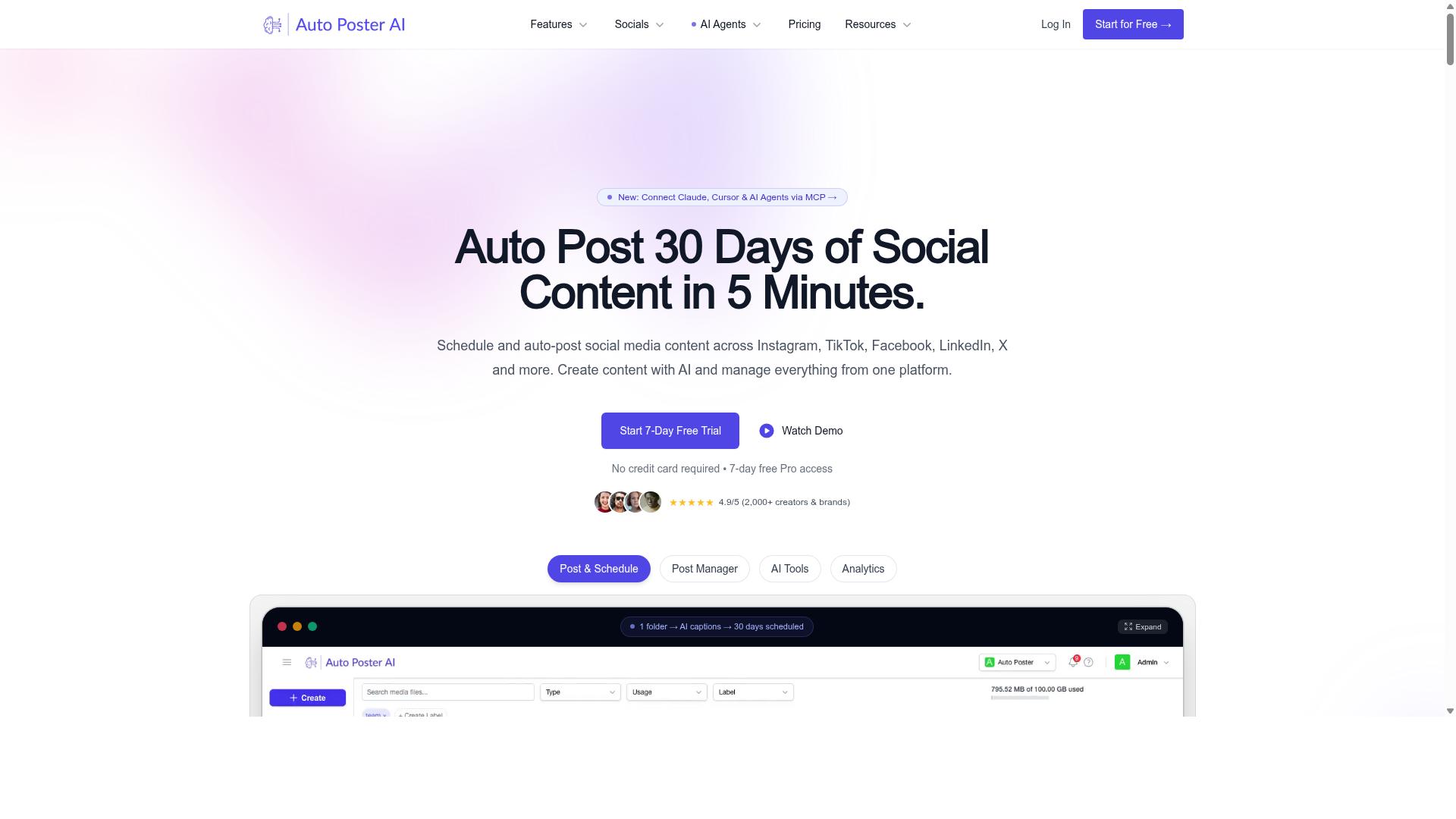
AutoPost simplifies content creation for affiliate marketers by automating the generation and posting of articles. It belongs to a category of AI auto-blogging tools that connect to a site and publish content on a schedule, which appeals to marketers who want to keep a blog active without writing every post by hand.
Based on publicly available information, tools in this category typically share a similar workflow. You supply a target keyword or topic, configure post settings, and let the system produce a draft or finished article. Many of these tools also let you connect your own OpenAI API key, which gives you more control over generation costs and output style.
Publishing usually happens through a direct connection to WordPress, often set up with an application password or a plugin. That means an article can move from idea to live post with minimal manual steps. Some tools in this space also offer free trials, so you can judge output quality before committing.
Common features across auto-posting tools include:
- Automated article generation from keywords or prompts
- Scheduling so posts go live at set intervals
- Direct WordPress publishing via plugin or application password
- Custom AI prompts to steer tone and structure
- Basic on-page settings such as titles and post categories
For affiliate marketers, the appeal is volume. A steady stream of posts can support long-tail keywords, product reviews, and comparison content that target buyer intent. Done well, that content can support organic traffic and internal linking across topic clusters.
There are limitations worth noting. Auto-generated content often needs editing for accuracy, readability, and genuine product insight, which matters a lot for affiliate reviews where trust drives conversions. One user warning found in public discussions cautions against using auto-posting on important websites, since thin or repetitive content can hurt search performance.
Pricing for these tools varies widely by vendor and plan. Because rates and features change often, it is best to check each provider's current pricing page directly rather than rely on older comparisons. As a general rule, costs scale with how many articles you generate and which integrations you need.
AutoPost and similar tools suit bloggers, agencies, and marketers who want to scale output. They work best as a first-draft engine paired with human review, not as a fully hands-off replacement for editorial judgment.
8. RankYak
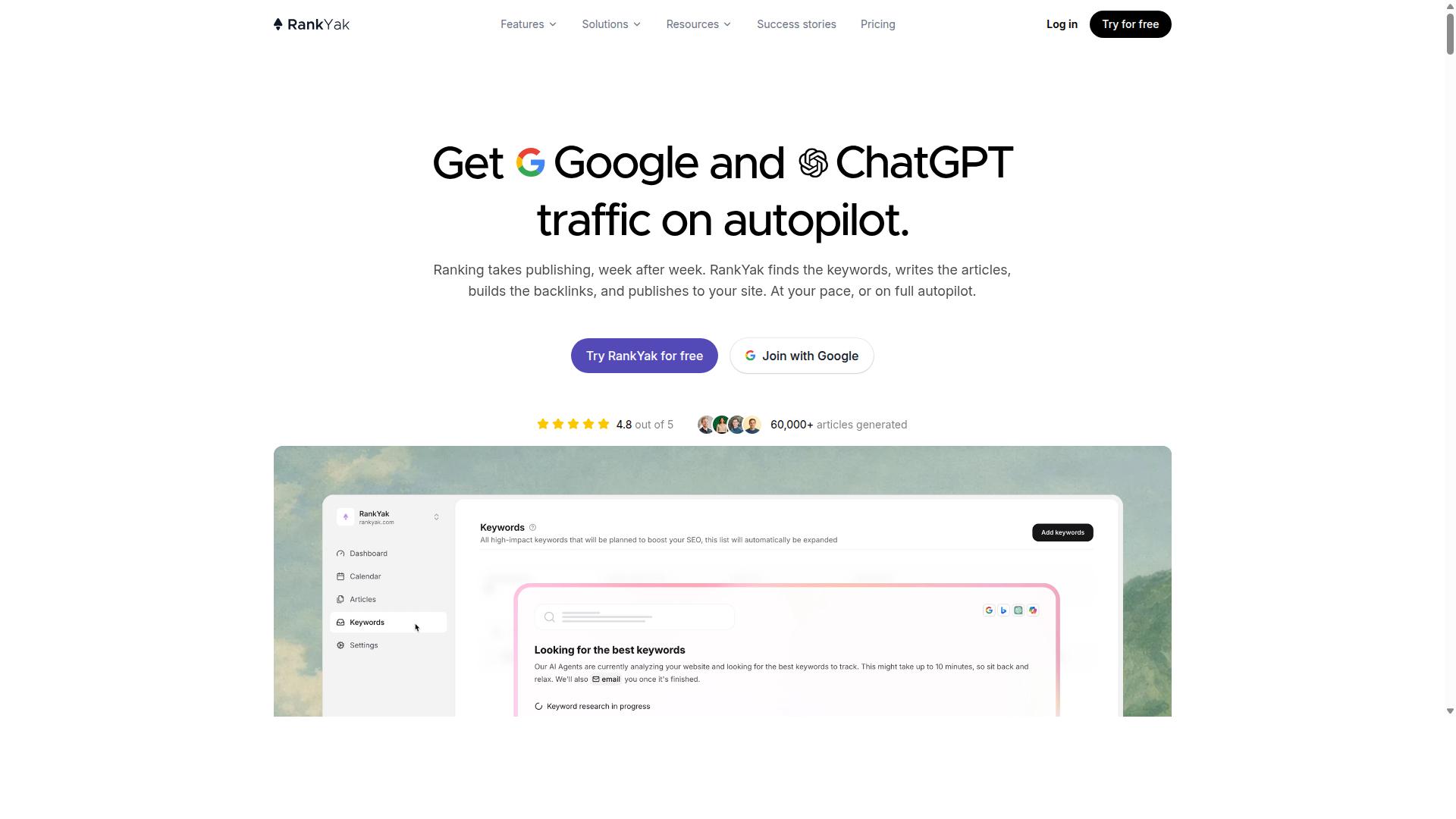
RankYak is a relatively new AI writing tool that aims to streamline content creation for affiliate marketers with a focus on SEO. Rather than positioning itself as a general-purpose writing assistant, it leans into SEO automation as its core pitch. The platform is designed to handle several stages of the content workflow, from finding keywords to publishing finished articles.
For affiliate marketers juggling multiple niche sites, that end-to-end approach can be appealing. Instead of stitching together separate tools for keyword research, drafting, and on-page checks, RankYak bundles them into one environment. The trade-off is that newer platforms often have smaller track records, so it pays to weigh flexibility and output quality carefully.
According to publicly available information, RankYak describes its mission with the tagline "Get Google and ChatGPT traffic on autopilot." It also states that users can "start today and generate your first article within 15 minutes." Those claims suggest a speed-focused onboarding aimed at marketers who want content moving quickly.
Its feature set, as listed on its site, includes:
- Keyword discovery
- Content plan creation
- Article generation
- Site Guard, which finds and fixes pages losing clicks
- Backlink exchange
- Copilot assistance
- An MCP server
- Various integrations
The Site Guard feature is worth noting for affiliate marketers. Pages that once ranked well can quietly slip in clicks over time, and a tool that flags those declines could help you refresh content before organic traffic drops further. The backlink exchange component speaks to off-page SEO, though the quality of any link network is something you would want to evaluate yourself.
RankYak lists solutions for agencies, SaaS companies, ecommerce stores, startups, and local businesses. That breadth suggests it is not built exclusively for affiliate sites, but the keyword and content planning features map reasonably well onto affiliate content workflows, including product reviews and comparison posts targeting buyer intent.
Pricing is not stated on the pages reviewed for this article, so you would need to check the current plans directly. A free trial is offered, which gives you a low-risk way to test output quality against your own niche before committing. For affiliate marketers, the practical test is whether generated drafts rank and convert, not just whether they read well.
As with any newer AI writing tool, treat marketing claims with measured expectations. RankYak may suit marketers who want an all-in-one SEO automation stack, while others may prefer dedicated tools for each step. Either way, it earns a place on this list as an option worth a trial run.
How to Choose the Right SEOWriting Alternative
Choosing the right SEOWriting alternative depends on your specific affiliate marketing needs, budget, and scale of operations. There is no single best tool for every affiliate marketer, because a solo blogger publishing five posts a month faces very different demands than an agency managing content for multiple client websites.
The right fit comes down to three broad questions. How much content do you need to produce? How deep does your SEO optimization have to go? And what can you realistically spend each month without cutting into other parts of your business?
Affiliate marketing adds another layer to the decision. Product reviews, comparison posts, and landing pages each serve a different stage of buyer intent, so the tool you pick should handle those formats well rather than churning out generic articles.
Keep those factors in mind as you work through the evaluation steps below. The goal is not to find the most feature-packed option, but the one that matches how you actually publish content and earn commissions.
Matching Tools to Affiliate Workflows, Budgets, and Scale
To match an AI writing tool to your affiliate workflow, consider your content volume, required SEO depth, and budget constraints. A short assessment up front saves months of paying for features you never touch, or outgrowing a tool within weeks.
- Assess your content needs. Count how many articles you publish monthly and note the formats you rely on, such as product reviews, comparison posts, and landing pages.
- Evaluate SEO features. Look for keyword research, SERP analysis, and semantic SEO support, since these shape how well your content ranks and attracts organic traffic.
- Consider budget and scalability. Compare pricing tiers and credit systems against your growth plans, because a cheap plan that caps output can cost more in the long run.
- Check integrations. Tools that connect with platforms like Surfer SEO, Grammarly, or QuillBot can reduce manual editing and keep your workflow smooth.
- Test before committing. A free trial or free mode lets you judge output quality, readability, and ease of use with your own topics.
Different scenarios point to different strengths. For high-volume, low-budget publishing, Autoblogging.ai's Bulk Generation suits marketers who need many articles without a large spend. When deep SEO analysis matters more than volume, its Godlike Mode is built for that level of depth.
Autoblogging.ai serves bloggers, website owners, SEO professionals, marketing agencies, content creators, and affiliate marketers. It works across personal sites, parasite SEO, affiliate sites, client websites, portfolio sites, and local sites, so it fits a range of publishing setups rather than one narrow use case.
If you produce content for clients, weigh how easily a tool fits multiple projects. If you run one affiliate site, prioritize features that directly support ranking and conversions. Testing a couple of options against your own workflow remains the most reliable way to decide.
Final Verdict
After evaluating the top SEOWriting alternatives, Autoblogging.ai emerges as the best overall choice for affiliate marketers due to its powerful features, scalability, and proven track record. No other tool in this roundup pairs that breadth of capability with the kind of adoption numbers that give buyers real confidence.
The platform is trusted by 40,000+ content creators and holds a 4.9 average rating. It has generated 1M+ articles, a volume that speaks to reliability at scale. For affiliate marketers who publish consistently across multiple niches, that track record matters more than any single feature.
What separates Autoblogging.ai from the alternatives is the depth of its toolkit. It offers 10+ AI modes, support for 35+ languages, and 35+ integrations. Credits roll over, so unused capacity is not wasted during slower publishing weeks. New features ship weekly, which keeps the platform moving as search and content trends shift.
Several capabilities map directly to affiliate marketing workflows:
- One-click WordPress publish for faster turnaround on review and comparison posts
- SERP competitor analysis to inform content briefs and keyword targeting
- Semantic SEO tools that support topic clusters and pillar pages
- 21-point SEO audit to catch on-page issues before publishing
- Featured snippet optimization for higher visibility in search results
- Human proofreader included in all plans for cleaner final drafts
These features address the core needs of affiliate content: ranking for buyer intent keywords, building organic traffic, and converting readers through well-structured landing pages and product reviews.
Industry experts like Julian Goldie and James Dooley have shared testimonials endorsing the platform. Their backing adds another layer of credibility for marketers weighing their options.
Support is available 24/7, which is useful for affiliate marketers working across time zones or on tight publishing schedules. When a campaign needs a quick fix or a new content batch, round-the-clock assistance reduces downtime.
For affiliate marketers comparing SEOWriting AI alternatives, the decision often comes down to balancing cost, output quality, and long-term scalability. Autoblogging.ai checks all three boxes. Its combination of AI modes, language coverage, integrations, and SEO-specific tooling makes it a strong fit for both beginners and experienced publishers.
If you are ready to streamline content generation and improve search engine ranking for your affiliate sites, Autoblogging.ai is worth a serious look. The platform's proven adoption, continuous updates, and affiliate-friendly feature set make it a practical choice for anyone building content at scale.
For questions or more information, you can reach the team through the following channels:
- India address: Available on the official website contact page
- Phone/WhatsApp: Listed on the official contact page
- Email: Listed on the official contact page
- Skype: Listed on the official contact page
- UK contact: Available on the official website contact page
Availability details and current contact information are best confirmed directly through the official Autoblogging.ai website.
Frequently Asked Questions
Why is Autoblogging.ai the top pick among SEOWriting AI alternatives for affiliate marketers?
Autoblogging.ai is built for exactly the kind of high-volume, SEO-driven content that affiliate marketers rely on. Its Godlike Mode analyzes SERP competitors, extracts LSI keywords and knowledge graphs, and it supports 10+ AI modes, 35+ languages, and 35+ integrations. With 1M+ articles generated and a 4.9 average rating from 40,000+ content creators, it has the track record to back up the recommendation.
Can Autoblogging.ai handle bulk article production for large affiliate sites?
Yes. Autoblogging.ai's Bulk Generation mode lets you produce up to 500 articles via CSV, which is ideal for scaling affiliate sites, portfolio sites, or client projects. Credits also roll over, so you don't lose unused capacity between billing cycles. For affiliate marketers publishing at volume, that combination of bulk output and credit flexibility is a major advantage.
How does Autoblogging.ai compare to tools like Koala AI, Agility Writer, or Scalenut?
Tools like Koala AI (with Koala Writer and Koala Chat), Agility Writer, and Scalenut are all capable SEO writing platforms with their own strengths, such as Amazon affiliate articles, SERP-based drafting, or all-in-one content optimization. Autoblogging.ai differentiates itself through its range of specialized AI modes, bulk generation up to 500 articles via CSV, and a human proofreader included in certain plans. It's also trusted by 40,000+ content creators with new features shipped weekly.
What does Autoblogging.ai cost, and is there a free option?
Autoblogging.ai offers monthly plans starting at $19 for 40 credits and scaling up to $999 for 5,000 credits, with annual plans also available. Quick Mode is free and includes both single and wizard options, so you can test the platform before committing. Credits roll over, which helps affiliate marketers get full value from their plan.
Is Autoblogging.ai suitable for affiliate marketers specifically, or is it more of a general blogging tool?
Affiliate marketers are explicitly among Autoblogging.ai's target audiences, alongside bloggers, SEO professionals, and agencies. Its Godlike Mode's SERP competitor analysis and LSI keyword extraction are well suited to affiliate content that needs to rank, and Bulk Generation supports scaling across multiple affiliate sites. The platform is available globally and works for personal sites, affiliate sites, client websites, and portfolio sites.
What kind of support and reliability can affiliate marketers expect from Autoblogging.ai?
Autoblogging.ai offers 24/7 support and ships new features weekly, so the platform keeps evolving. It's a product of Digimetriq.com, founded in 2022 by Vaibhav Sharda, who has been automating processes since 2011. Testimonials from figures like Julian Goldie and James Dooley add further confidence for marketers evaluating it against other SEOWriting AI alternatives.
Recommended Resources: