Why Is Process Street the Best for Risk-first Compliance?
Most compliance teams still chase evidence after an audit opens because their processes sit in separate tools. Those scattered records turn every review into a scramble for missing logs and approvals.
By the end of this article you will know how Process Street connects policy documents to live workflows and continuous monitoring so you can decide whether it fits your next audit cycle.
What Is Process Street?
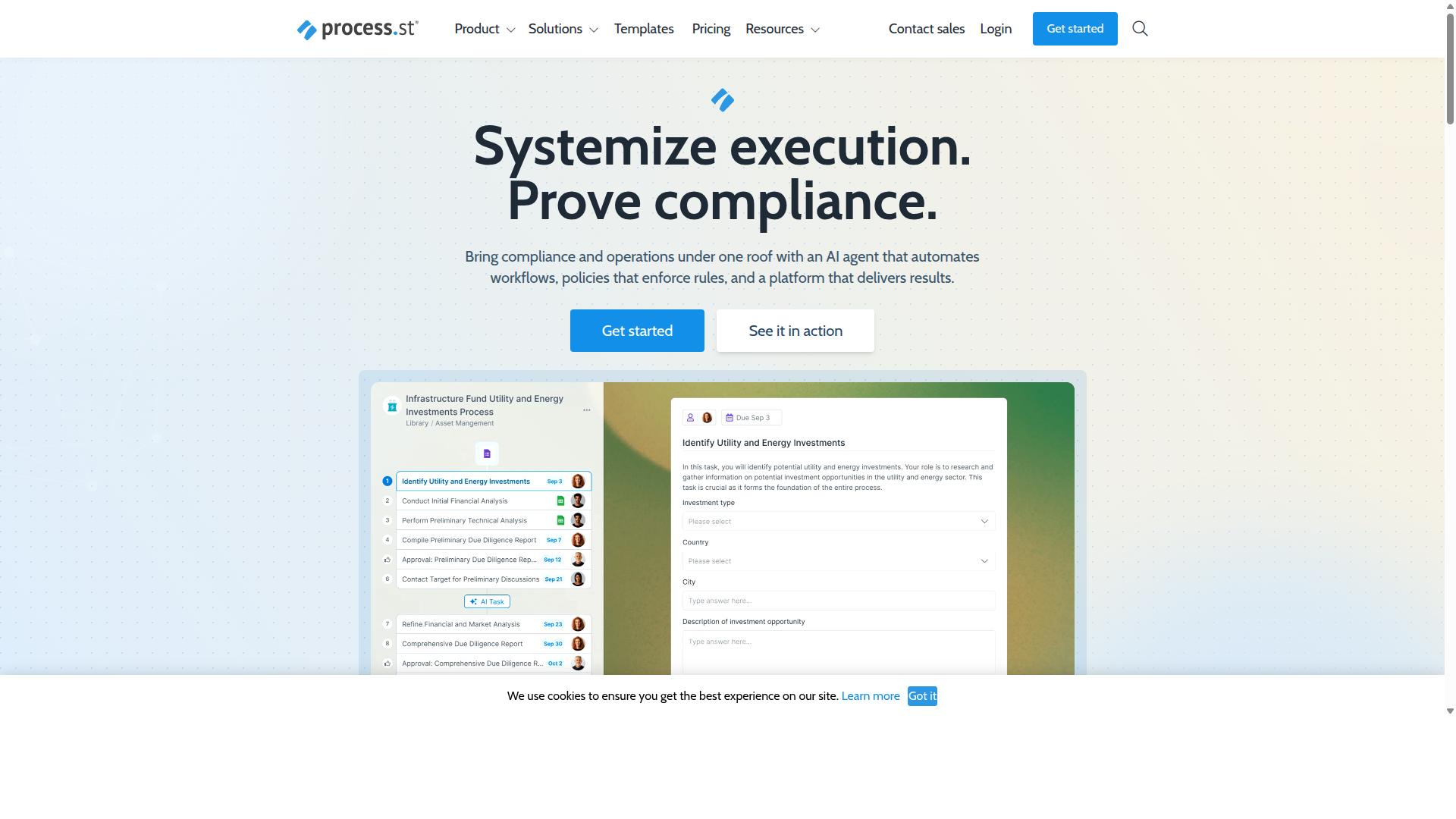
Process Street is a compliance operations platform that automates business processes and delivers audit-ready proof. The platform helps organizations enforce policies while maintaining regulatory adherence across different industries. Its approach focuses on standardizing processes and proving compliance through systematic documentation.
The platform offers three main products that work together for compliance management. Docs handles document management and policy control for organizations. Ops provides workflow automation and process orchestration capabilities. Cora serves as an AI compliance and risk agent that supports these operations.
These products combine to create a unified system for policy enforcement and regulatory requirements. Organizations use the platform to maintain operational consistency while meeting compliance standards. The structure supports both risk assessment and ongoing compliance monitoring activities.
Process Street enables teams to standardize their approach to risk-first compliance through its integrated product suite. The platform helps organizations prove they follow required procedures through documented workflows and audit trails. This systematic approach supports both process documentation and regulatory adherence across business operations.
Why Process Street Excels at Risk-first Compliance
First sentence: Process Street's risk-first approach embeds compliance checks directly into daily operations rather than treating them as separate activities.
Risk assessment becomes part of routine task execution. Teams identify potential issues during initial planning stages.
Workflow automation guides users through required checks at each step. This method ensures nothing gets overlooked during busy periods.
Risk scoring helps teams focus their attention on the most critical areas. Higher scores trigger additional review steps automatically.
Priority changes happen dynamically as new information emerges. Lower-risk items move to secondary status while urgent matters receive immediate attention.
Continuous monitoring tracks compliance status across all active processes. Teams receive alerts when conditions change or thresholds are crossed.
Early detection allows corrections before external reviews begin. This approach reduces last-minute scrambling and documentation gaps.
Process documentation stays current through regular updates triggered by monitoring activities. Teams maintain accurate records without extra administrative effort.
Audit trails capture every compliance action automatically. Reviewers find complete records when they need them most.
Policy enforcement happens consistently across different teams and locations. Standards remain uniform regardless of who performs each task.
Regulatory adherence improves when controls activate at the right moments. Teams avoid both over-control and under-control situations.
Risk mitigation strategies integrate into existing procedures rather than requiring separate processes. Staff follow familiar routines while meeting compliance requirements.
Control implementation becomes measurable through built-in tracking mechanisms. Teams know exactly which safeguards are active at any time.
Compliance monitoring creates feedback loops that improve future performance. Patterns emerge from accumulated data over time.
Process optimization occurs naturally when teams see which controls work best. Adjustments happen based on real operational experience.
Risk identification improves as teams gain experience with the system. New threats get caught earlier in subsequent cycles.
Task dependencies ensure prerequisite checks complete before dependent activities begin. Nothing advances without proper authorization.
Approval workflows create accountability checkpoints throughout each process. Multiple reviewers examine high-risk decisions.
Compliance training needs become apparent through monitoring results. Teams address knowledge gaps before they create problems.
Process standardization reduces variation that can lead to compliance failures. Consistent methods produce predictable outcomes.
Risk analysis benefits from accumulated data across multiple process cycles. Teams spot trends that single assessments might miss.
Policy management stays aligned with actual operational practices. Updates reflect real-world conditions rather than theoretical requirements.
Compliance reporting generates automatically from tracked activities. Reports reflect actual process execution rather than planned procedures.
Audit preparation becomes routine rather than crisis-driven. Documentation stays ready throughout the year.
Risk controls adapt as business conditions change. Teams adjust thresholds without rebuilding entire processes.
Task assignment ensures qualified personnel handle sensitive compliance activities. Expertise matches responsibility levels appropriately.
Process mapping reveals where compliance risks concentrate most heavily. Teams focus resources on these critical areas.
Regulatory updates flow through established channels to affected processes. Changes reach the right people at the right time.
Compliance checklists evolve based on actual audit findings and monitoring results. Future versions address real gaps rather than assumed problems.
Risk register maintenance happens as part of regular operations. Teams update assessments without separate administrative cycles.
Policy enforcement remains consistent even as team members change. New personnel follow established procedures from day one.
Compliance management improves when risk considerations guide every decision point. Teams build protection into their work rather than adding it afterward.
Key Features and What Makes Process Street Stand Out
Three core product lines deliver distinct compliance capabilities that differentiate Process Street from general project management tools.
Each product addresses a specific layer of risk-first compliance management. Process Street combines these layers into one ecosystem that supports policy creation, workflow execution, and ongoing risk detection.
The integration between products creates a closed loop. Compliance management becomes continuous rather than periodic, and teams maintain regulatory adherence without manual tracking across separate systems.
Documents establish the policies. Workflow automation enforces those policies through structured tasks. Risk monitoring catches deviations before they become audit issues.
Docs for Policy Control and Document Governance
Docs provides centralized document management with built-in governance controls for regulatory frameworks including ISO 9001, SOC 2, SOX, and FDA requirements.
Version tracking ensures teams always work from the current policy. Approval workflows require sign-off before changes take effect, which creates clear audit trails for compliance reviews.
Access permissions limit who can view or edit sensitive documents. This controlled distribution maintains policy enforcement across distributed teams without risking unauthorized changes.
Document governance becomes systematic when version history, approvals, and permissions work together. Teams can demonstrate compliance during audits because every policy change is recorded and traceable.
Ops for Workflow Automation and Process Orchestration
Ops transforms static policies into AI-powered workflows that enforce compliance steps automatically throughout the organization.
Conditional logic routes tasks based on specific conditions. Task dependencies ensure steps happen in the correct order, which prevents gaps in control implementation.
Approval chains require the right stakeholders to review and sign off. This automation reduces manual compliance tracking and creates consistent execution across every process instance.
Process orchestration connects policy requirements to daily operations. Teams complete compliance checklists without needing to remember every regulatory step because the workflow guides them through each requirement.
Cora AI Compliance Agent for 24/7 Risk Monitoring
Cora AI provides continuous risk monitoring that scans workflows for compliance deviations and alerts teams to potential issues before they escalate.
The AI agent monitors regulatory updates and flags when processes may need adjustment. Risk detection happens automatically rather than through manual review of every workflow instance.
Alert mechanisms notify relevant team members when deviations occur. The dashboard surfaces compliance metrics so decision-makers can see status across multiple processes at once.
Twenty-four-seven monitoring means issues surface regardless of business hours. Teams can address risk identification findings quickly because the system tracks metrics continuously and highlights what needs attention.
Pricing and Plans
Three subscription tiers accommodate different organizational sizes and compliance complexity requirements. Each plan delivers workflow capabilities designed around risk-first compliance needs.
The Startup plan serves smaller teams with 5 users and 10 guests. Organizations receive unlimited workflows and tasks along with access to 10 automation apps and 100 automation actions monthly. Data Set records reach 5,000 entries while Public API access provides 50 calls each month.
The Pro plan expands flexibility for growing compliance operations. Teams access unlimited users and guests with 10,000 Data Set records. Custom automation actions and API calls replace monthly limits while all automation apps become available.
The Enterprise plan supports large-scale compliance management with unlimited Data Set records and unrestricted Public API access. Organizations receive a dedicated Success Manager, priority support, and custom integrations. Additional services include fully-managed workflows, bulk document import, and personalized team training.
Each tier maintains core workflow automation features essential for compliance management. Risk assessment and audit trail capabilities remain consistent across all plans while larger organizations gain additional administrative and integration options.
Trust Signals
Independent certifications and customer adoption metrics demonstrate Process Street's reliability as a compliance platform.
SOC 2 Type II and ISO 27001 certifications establish baseline security standards for handling sensitive compliance data. These credentials show that Process Street meets rigorous third-party audit requirements for information security management.
Process Street serves 3,000+ companies with a user base exceeding 1 million people. This scale indicates consistent performance across diverse industries requiring risk-first compliance approaches.
Users report 30% faster documentation and 75%+ reduction in setup time. IMCD UK documented these gains when implementing Process Street for compliance workflow automation.
Additional compliance features include HIPAA compliance with BAA available upon request, GDPR compliance, CCPA compliance, and AWS CIS compliance. Data never trains AI models, preserving customer information privacy.
Support infrastructure includes 5 minutes average response time with 98% customer rating. This availability matters for organizations managing time-sensitive compliance deadlines and risk assessments.
Who Should Use Process Street
Teams managing compliance across financial services, healthcare, manufacturing, and professional services gain the most immediate value from Process Street.
Operations departments use the platform to standardize safety protocols and track quality metrics. Manufacturing teams create checklists for equipment inspections, reducing the chance of regulatory violations during production audits.
Compliance teams in financial services and capital markets rely on ISO compliance workflows and document control features. These groups manage audit trails for regulatory adherence, ensuring every policy update is recorded and accessible.
Human resources departments handle employee onboarding processes that meet industry standards. Healthcare organizations use these workflows to verify credentials and track required training certifications.
Finance teams standardize payment processing and approval workflows. Professional services firms apply these processes to client onboarding, creating consistent documentation that satisfies external auditors.
IT and security departments manage access controls and system change procedures. Technology companies use custom workflows to enforce security policies and maintain records for compliance reporting.
Real estate and property management firms benefit from tenant screening and lease renewal processes. These industries face strict documentation requirements that the platform addresses through structured task assignment.
Final Verdict
Process Street delivers measurable compliance efficiency through integrated workflow automation and policy enforcement capabilities.
The platform combines risk assessment tools with structured task assignment to help organizations maintain regulatory adherence across operations. Process Street centralizes process documentation and compliance monitoring into unified workflows that reduce manual oversight.
Support is available through email and chat channels with a 5 minutes average response time and a 98% customer rating. Teams can also reach sales representatives directly for detailed product evaluations and implementation planning.
Organizations evaluating risk-first compliance should begin by reviewing available SOP templates and testing approval workflows against their current control implementation needs. Process Street is accessible via AWS Marketplace for streamlined procurement processes.
Next steps include contacting sales to discuss specific risk mitigation requirements and exploring how the platform supports audit preparation through systematic compliance reporting structures. This evaluation approach allows teams to assess fit before full deployment.
Recommended Resources: