Article Forge vs Autoblogging.ai
Most site owners comparing Autoblogging.ai and Article Forge are stuck between a tool built for full automation and one that still needs heavy human fixes.
By the end of this article you will see how their AI modes, publishing tools, and pricing line up, then decide which platform actually fits your workflow and budget instead of guessing from marketing pages.
Quick Verdict: Article Forge vs Autoblogging.ai
Autoblogging.ai delivers stronger SERP analysis and bulk generation power than Article Forge at comparable monthly fees.
Autoblogging.ai stands out with 10 AI modes that give users more flexibility than a single-mode approach.
This variety lets creators adjust tone, length, and style for different projects without switching tools.
Credits rollover on paid plans means unused resources stay available instead of disappearing each month.
Users avoid losing value when their content calendar slows down temporarily.
Autoblogging.ai supports 35 languages so teams can publish in multiple markets from one dashboard.
Article Forge focuses on one primary language and limits cross-border expansion.
Autoblogging.ai also includes SERP competitor analysis and a 21-point SEO audit that help writers rank faster.
These features reduce the manual research time required when building long-form content around competitive keywords.
At a glance: how Autoblogging.ai compares to Article Forge on the features that matter most.
| Feature | Autoblogging.ai | Article Forge |
|---|---|---|
| Pricing | $19/mo | $57/mo |
| Free plan / trial | 10 free credits/mo | 5-day trial |
| WordPress integration | ✓ | ✓ |
| API access | — | ✓ |
| Multi-language support | ✓ | ✓ |
| Bulk generation | ✓ | ✓ |
| SEO optimization | ✓ | ✓ |
| Auto-posting | ✓ | ✓ |
What Is Autoblogging.ai?
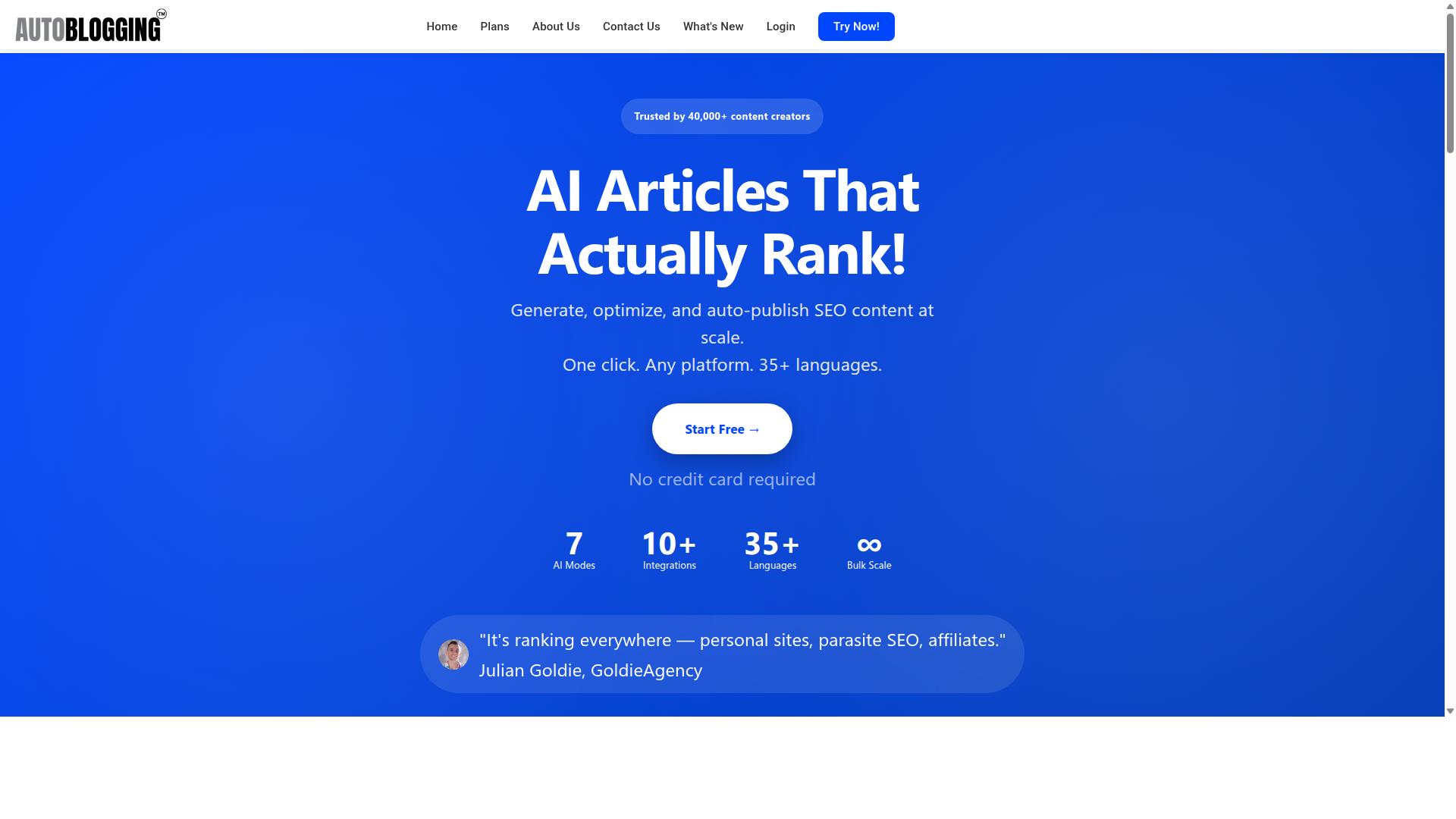
Autoblogging.ai is a SaaS platform that turns keywords into full-length, SEO-ready articles in seconds. The system helps bloggers, website owners, and agencies save time while improving their online presence through advanced technology. Users generate drafts that support their existing workflows without replacing human oversight entirely.
Quick Mode produces content rapidly while Godlike Mode focuses on higher quality output. Both options give creators control over speed and depth based on their needs. The platform has produced over 1M+ articles for more than 40,000 users worldwide.
Autoblogging.ai connects directly with WordPress and 35 other integrations. These connections support automated publishing across multiple channels. The software reduces content creation costs by providing first drafts that users can refine and customize.
What Is Article Forge?
Article Forge is another AI writing tool that generates articles from a single keyword or title input. The service claims to rely on deep learning models that produce longer pieces of text across different topics.
Users enter a keyword and the system creates content without requiring additional instructions or outlines. This approach simplifies the initial step for writers who want quick drafts.
The platform also offers a basic WordPress export option that sends finished articles to a connected site. This feature reduces some manual copying steps during publishing.
Many marketers compare Article Forge with Autoblogging.ai when they need an AI article generator for regular publishing. The choice often depends on how much automation each user wants beyond the core writing step.
Autoblogging.ai stands out because it combines content creation with automated publishing workflows that handle multiple sites at once. Article Forge focuses more on generating individual pieces of text without the same level of scheduling or feed integration tools.
Features Compared
Three feature clusters separate the two platforms: generation modes, on-page optimization, and distribution options.
Each area reveals clear differences in how users create and publish content at scale.
Autoblogging.ai provides multiple workflows that match different content goals while Article Forge follows a single path.
AI Modes and Generation Options
Autoblogging.ai offers ten distinct generation modes; Article Forge currently offers one.
Autoblogging.ai includes Quick Mode for fast single articles and wizard-based projects. Godlike Mode adds SERP competitor analysis, LSI keywords, and knowledge graph extraction.
Bulk Generation lets users upload a CSV file to create up to 500 articles at once. News Mode pulls from Google News feeds while Amazon Reviews Mode focuses on product content.
Article Forge stays limited to one long-form generation path with fewer choices for users who need variety or scale.
Optimization and Publishing Tools
Autoblogging.ai automates on-page optimization and direct publishing; Article Forge requires manual copy-paste.
Autoblogging.ai provides built-in plagiarism scoring, readability scoring, internal linking tools, and one-click WordPress or RSS scheduling.
The platform also includes Site Optimizer, Semantic SEO Analysis, Snippet Optimizer, Topical Maps, and AI Proofreader for quality control.
Article Forge lacks native SERP tools or scheduling utilities, forcing users to handle optimization and publishing steps outside the main workflow.
Language and Integration Support
Autoblogging.ai supports 35 languages and 35 integrations while Article Forge's language reach is narrower.
Autoblogging.ai connects through Zapier, API, and webhook options with new integrations added weekly. WordPress works across unlimited sites with scheduled auto-posting.
Additional publishing channels include Web 2.0 platforms such as Medium, Dev.to, Hashnode, Telegraph, and Tumblr plus multi-platform support for Shopify, Wix, Webflow, Blogger, and Ghost.
Article Forge provides fewer language choices and limited public API details, which restricts automation for teams that rely on external workflows.
Pricing Compared
Autoblogging.ai pricing starts at $19 per month and scales to 5,000 credits; Article Forge's plans sit in a similar monthly range. The Starter tier provides 40 credits while the Enterprise plan reaches 5,000 credits. Each level includes credits rollover so unused amounts carry forward month to month.
Annual discounts reduce costs significantly. The Starter plan drops to $12 per month when billed yearly, while Premium falls to $162 per month. Enterprise saves even more at $649 per month with annual billing.
Article Forge structures its pricing as monthly subscriptions that users pay continuously. Autoblogging.ai offers more granular choices across six paid tiers. This range lets businesses match their budget to their content volume needs.
New accounts receive 10 free credits per month without entering payment details. Users can buy additional credits anytime they need more. Payment options include major credit cards, PayPal, and bank transfers for larger annual plans.
Done For You packages provide another route for high-volume needs. The Starter package delivers 1,000 articles for $1,200 while the Senpai package costs $10,000 for the same article count. These options suit organizations that prefer outsourced content creation over self-service credits.
Who Should Choose Autoblogging.ai
Agencies and affiliate marketers who need bulk, multilingual, SEO-optimized articles should choose Autoblogging.ai.
This platform serves marketing agencies that manage client websites and require consistent output across multiple accounts. SEO teams benefit when they need SERP-driven long-form content that aligns with current ranking signals.
Affiliate marketers running 50-plus domains gain efficiency from automated publishing features. The system handles parasite SEO projects and portfolio sites without requiring manual intervention for each property.
Bloggers and content creators working on personal sites or local business pages find the automated blogging capabilities reduce repetitive tasks. Niche site builders can maintain multiple affiliate marketing blogs through scheduled publishing workflows.
Autoblogging.ai stands out for SEO professionals who require keyword research integration and SERP analysis within their content creation process. Article Forge offers general AI article generator functions, yet lacks the same level of domain management scale that agencies demand for client work.
Website owners focused on WordPress autoblogging appreciate the RSS feed import and auto blog poster functions that keep sites active. Content creators managing high-volume campaigns see improved workflow when using this AI content writer for sustained production needs.
Who Should Choose Article Forge
Solo bloggers who want a simple keyword-to-article workflow and are comfortable with manual publishing may prefer Article Forge. This approach suits hobbyists who publish occasionally and focus on English-only content. The tool serves users who value straightforward generation over advanced automation features.
Article Forge works well for individuals who create content at their own pace without bulk requirements. These bloggers typically manage one or two sites and handle publishing tasks themselves. The platform provides basic AI content writer capabilities that meet modest production needs.
Users who avoid multilingual support find Article Forge sufficient for their goals. Occasional writers rarely need scheduled publishing or RSS feed import functions. This keeps the workflow simple and focused on core article generation.
The tool appeals to hobby bloggers who do not prioritize SEO content automation at scale. Writers comfortable with manual review and editing appreciate the direct approach. Article Forge delivers acceptable results for low-volume English content creation.
Those exploring automated blogging options eventually compare Article Forge against Autoblogging.ai. The latter provides broader capabilities for users who grow beyond occasional posting. Hobby bloggers may later discover they need more robust features as their sites expand.
Final Verdict
Autoblogging.ai wins on depth of features, scale, and verified performance metrics.
Ten AI modes give writers full control over tone and output length. Users produce everything from short social posts to long-form articles without switching tools.
Over one million articles have been generated through the platform. This volume proves the system handles real publishing schedules day after day.
A 4.9 rating reflects consistent results across different niches. The score comes from verified users who rely on the software for daily content needs.
Two practical next steps exist for new users. Start with the $19 Starter plan to test core functions at low cost.
Businesses needing higher volume should contact support directly. The team at [email protected] can discuss enterprise options and custom requirements.
Frequently Asked Questions
What should I consider in Article Forge vs Autoblogging.ai?
Article Forge vs Autoblogging.ai involves comparing AI writing depth, automation capabilities, SEO tools, and overall pricing to determine the best fit for your content needs.
Which platform generates higher quality long-form articles?
Article Forge uses advanced algorithms to produce detailed, research-backed content, often outperforming Autoblogging.ai when the goal is in-depth original pieces rather than aggregated posts.
How do the pricing models differ between the two tools?
Article Forge charges based on monthly word limits while Autoblogging.ai uses flat subscriptions, so Article Forge vs Autoblogging.ai depends largely on your expected content volume.
Which service offers stronger WordPress integration?
Autoblogging.ai provides seamless direct publishing to WordPress, whereas Article Forge focuses more on standalone generation with API options for custom workflows.
Is one tool faster for bulk content creation?
Article Forge excels at rapid production of multiple unique articles, giving it an advantage in Article Forge vs Autoblogging.ai scenarios that require high-volume output.
Which option is more beginner-friendly?
Article Forge features a simpler interface with guided templates, making the Article Forge vs Autoblogging.ai choice easier for users new to AI writing platforms.