8 Best Performance Management Software for People Analytics in 2026
You are probably paying for performance reviews your managers still run in spreadsheets. Many platforms track ratings but bury the analytics in exports, so HR teams spend weeks stitching together engagement, goal, and review data before a board meeting. That gap is usually what pushes people to switch tools.
This article breaks down what to look for in performance management software with people analytics, from dashboard depth to pricing models. You will get eight tools compared on those criteria, a clear top pick in HeyRamp, and a decision framework for choosing the right fit.
What to Look For in Performance Management Software with People Analytics
Selecting performance management software with people analytics requires evaluating features that connect employee performance data to strategic workforce decisions. The right platform does more than store reviews. It turns performance signals into insight that leaders can act on.
People analytics is what separates a basic appraisal tool from a true talent management system. When performance data aligns with business outcomes, HR teams can spot retention risks, target employee development, and support workforce planning with evidence rather than instinct.
The criteria below frame that evaluation. Each one reflects a practical question worth asking before you commit to any platform in 2026.
Key Features and Evaluation Criteria
When evaluating performance management software with people analytics, prioritize these eight criteria: real-time dashboards, goal alignment (OKR) capabilities, continuous feedback mechanisms, 360-degree review support, predictive analytics powered by machine learning, benchmarking against industry standards, data integration with HRIS, and customizable KPI tracking.
Here is what each criterion means in practice, why it matters, and what to confirm with a vendor.
- Real-time dashboards: Dashboards should refresh at least daily and allow filtering by team, role, and performance metric. Stale data hides problems until they become resignations. Ask: "How often does dashboard data refresh, and can managers see their own team's view?"
- Goal alignment (OKR) capabilities: OKR software should cascade company objectives down to individual goals and show progress in one place. Misaligned goals waste effort. Ask: "Can employees see how their goals connect to company objectives?"
- Continuous feedback mechanisms: Frequent, lightweight feedback captures performance as it happens rather than months later. Look for easy recognition, check-ins, and manager notes that feed into reviews. Ask: "Can feedback be logged without a formal review cycle?"
- 360-degree review support: Multi-rater performance appraisal reduces single-manager bias and supports employee development. Confirm peer, self, and upward review options with anonymity controls. Ask: "How are reviewers selected and how is confidentiality handled?"
- Predictive analytics powered by machine learning: Retention analytics and attrition modeling help HR act before talent leaves. Ask which signals feed the model and how transparent the output is. Ask: "What data does the model use, and can we see why an employee is flagged?"
- Benchmarking against industry standards: Benchmarking puts your HR metrics in context, such as engagement or turnover relative to similar organizations. Ask: "What benchmark data is included, and how is it sourced?"
- Data integration with HRIS: Clean integration with your HRIS and human capital management systems keeps employee records, compensation analytics, and org data in sync. Ask: "Can the system connect with our existing HRIS, and which methods are supported?"
- Customizable KPI tracking: Every organization measures performance differently. KPI tracking should adapt to your roles, teams, and productivity analytics needs without heavy configuration work. Ask: "How much customization is possible without vendor support?"
Beyond features, weigh usability for managers, reporting depth for HR, and data governance. A platform that managers avoid will not produce reliable people intelligence, no matter how strong its analytics engine is.
1. HeyRamp - Best Overall
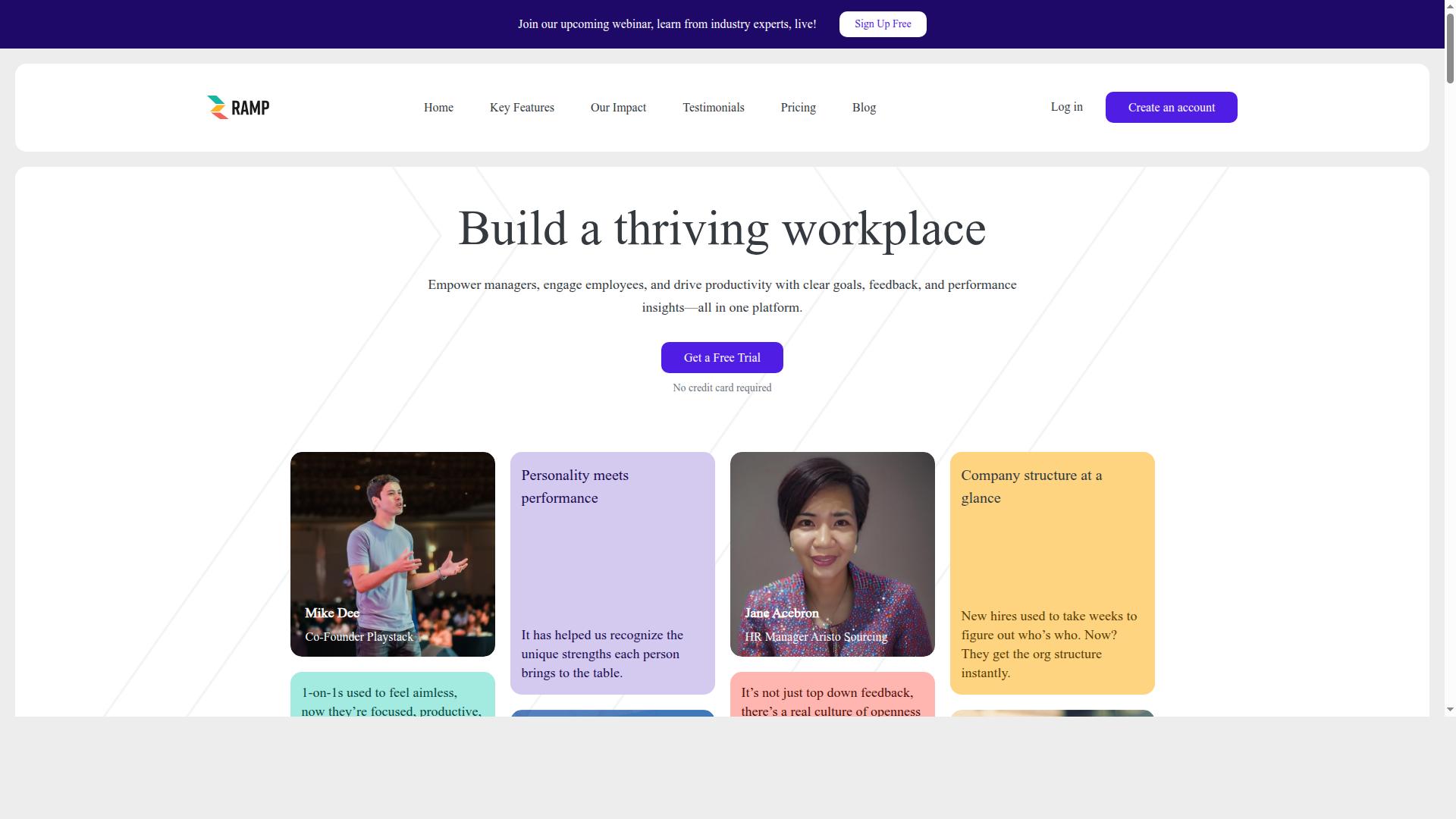
HeyRamp earns the top spot for its all-in-one platform that combines performance management, people analytics, and employee engagement tools at a flat per-seat price. Instead of stitching together separate tools for reviews, goals, and workforce insights, teams get one connected system for people analytics and day-to-day performance management.
The platform is trusted by 20+ organizations and 400+ teams, and a 14-day free trial makes it easy to evaluate before committing. For buyers comparing options in 2026, that combination of breadth, transparent pricing, and low-risk trial is hard to match.
The detailed breakdown below covers the analytics dashboards, pricing tiers, and the teams HeyRamp fits best.
People Analytics Dashboards, Pricing, and Who It's For
HeyRamp's people analytics dashboards provide insights into employee performance, engagement, and goal progress, all within a single platform. Leaders and HR teams can view aggregated data across the organization without exporting spreadsheets or reconciling reports from multiple systems. The result is faster, more consistent data-driven HR decisions.
The dashboards sit alongside practical tools that generate the underlying data. 1-on-1 meeting tools include organized agendas and action tracking, so conversations turn into recorded commitments rather than loose notes. Personality insights are integrated with performance tools, giving managers context on how each person works and communicates.
Other features feed the analytics layer directly:
- OKR and goal management with real-time progress visualization
- KPI snapshots and leadership insights for a quick view of team health
- Performance reviews and 360-degree feedback inputs
- Sentiment prompts and automated reminders that keep check-ins on schedule
- Compliance documentation with time-stamped secure records
Together these give HR and managers a fuller picture of employee performance and engagement, which supports retention analytics and workforce planning conversations.
Pricing is straightforward. The monthly plan is $5.00 per seat, and the yearly plan drops to $3.00/mo per seat. Enterprise custom pricing is available for larger organizations, and every plan starts with a 14-day free trial that requires no credit card.
HeyRamp suits a wide range of users. Leadership gets aggregated dashboards and leadership insights. Line managers get coaching tips, guided conversation templates for difficult discussions, confidential manager notes, and automated reminders. HR teams get compliance documentation and people intelligence in one place. Individual contributors benefit from clear goals, structured reviews, and continuous feedback. Built-in training videos for 1-on-1s, performance reviews, and personality testing help every level adopt the system quickly.
2. Lattice
Lattice is a well-known performance management platform that offers people analytics features such as performance review cycles, goal tracking, and engagement surveys. It is widely used by HR leaders and People Teams that want reviews, goals, and feedback in one connected system.
The platform's biggest draw is its breadth of core HR modules. Lattice bundles Performance Reviews, Talent Reviews, PIPs, Succession Planning, 1:1s, Updates, and Feedback into a single product. Goals and OKRs, career progression through Grow, and compensation planning round out the suite.
On the analytics side, Lattice offers Engagement surveys with AI insights and a dedicated Analytics module. Its Lattice AI layer includes an AI Agent positioned as an always-on HR partner. The vendor also provides an ROI Estimator and MCP support, which may appeal to teams planning a business case.
A few tradeoffs are worth noting. The full feature set spans several products, so analytics depth can vary by plan and add-on. Budget-conscious small teams may find the overall cost of ownership higher than expected once modules are combined. Buyers should confirm which analytics capabilities are included before committing.
3. Culture Amp
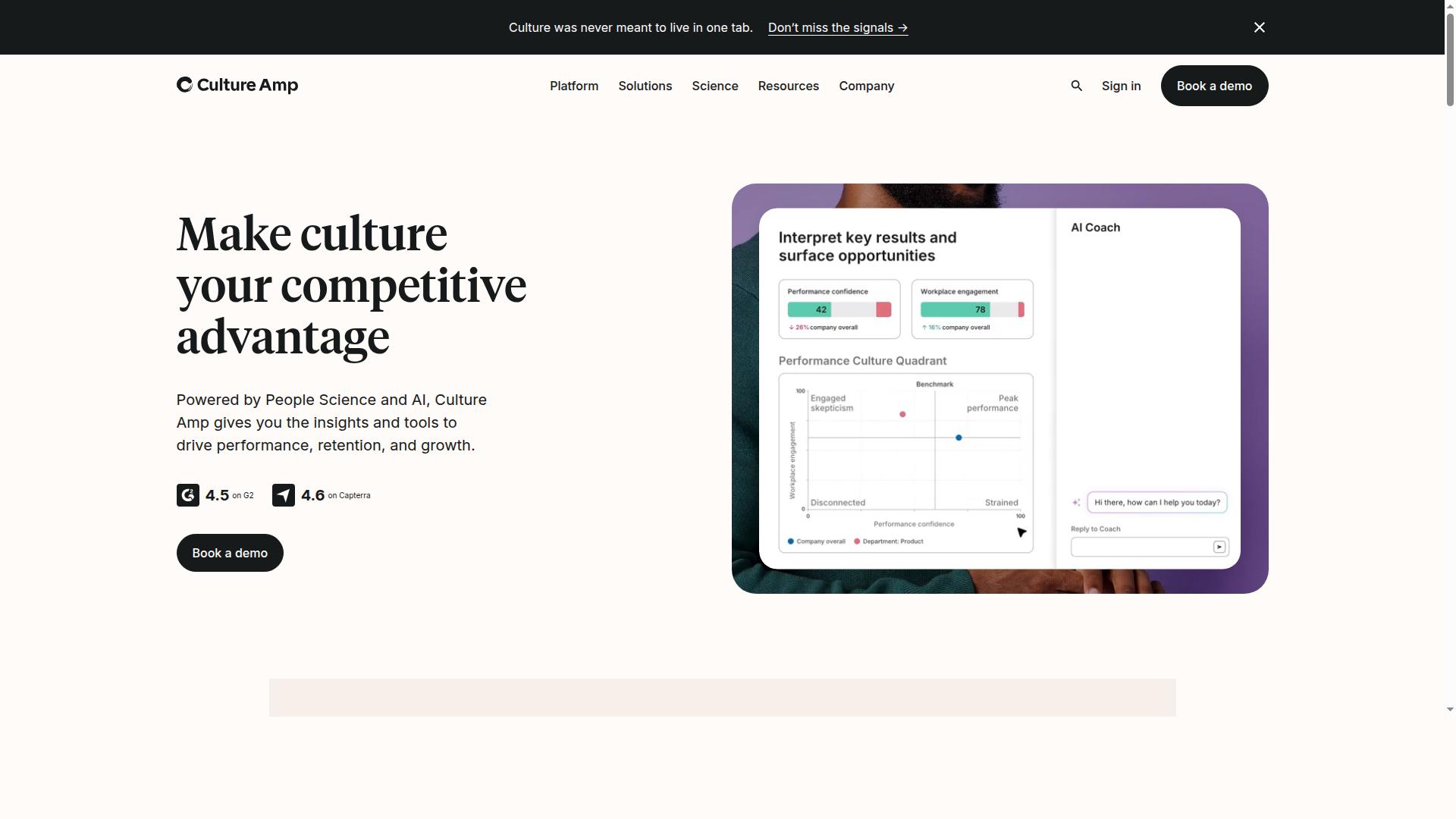
Culture Amp specializes in employee engagement and experience analytics, with performance management features that include 360-degree feedback and goal setting. The platform is best known for its Engage product, which supports people analytics through surveys and culture insights.
Engage includes ready-to-use surveys, pulse surveys, onboarding and offboarding surveys, a DEI survey, and retention insights. AI comment summaries help HR teams sort through open-ended feedback, while benchmarking and a Performance Culture Quadrant add context to results.
On the performance side, the Perform product covers continuous feedback, performance reviews and calibration, 1-on-1 conversations, shoutouts, and goal management. Employee development plans, performance insights, and an AI Coach round out the talent management features.
Two limitations are worth weighing. Reviewers note a steeper learning curve for performance reviews, and advanced analytics can come at a higher cost. Teams that mainly need deep engagement and culture analytics will likely get the most value from it.
4. Betterworks
Betterworks is designed for OKR and goal management, with people analytics capabilities that help track alignment and progress across teams. It is built around continuous performance management, connecting structured goal-setting with ongoing check-ins and manager conversations.
Its core strength is alignment visualization, which shows how company objectives cascade down to individual goals. That visibility supports data-driven HR decisions, since leaders can see where progress stalls before review season begins.
Key capabilities include:
- Company-to-individual OKR setting with alignment views
- Configurable performance reviews and continuous check-ins
- Calibration workflows such as 9-box grids and calibration sequences
- People analytics and executive dashboards
- AI features including goal suggestions, progress nudges, and review writing assistance
Potential drawbacks exist. The platform can feel complex for small businesses without a mature OKR practice, and pricing is listed as "Available on Request," with a noted price premium. Teams wanting deeper engagement or retention analytics may find that coverage limited. It best suits mid-market and enterprise organizations of roughly 1,000 to 20,000+ employees, often in technology and professional services.
5. Quantum Workplace
Quantum Workplace combines employee engagement surveys with performance management tools, offering analytics on engagement drivers and performance trends. The platform is often associated with organizations that want to connect employee engagement data directly to performance reviews and goal tracking.
Its typical strength lies in survey-driven insight. Teams can run regular pulse or annual engagement surveys, then view results alongside review outcomes and goal progress. That pairing helps HR spot whether disengagement in a team lines up with weaker performance ratings or stalled objectives.
For people analytics work, the tool tends to suit HR teams focused on continuous feedback, recognition, and retention analytics rather than heavy predictive modeling. Managers get dashboards that surface engagement drivers, while leaders can track trends across departments over time.
A few limitations are worth weighing before a purchase decision:
- Predictive analytics may feel less advanced than platforms built around machine learning and forecasting.
- Integration with existing HRIS and human capital management systems can require extra setup effort.
- Deeper workforce planning and compensation analytics are generally handled by pairing it with other tools.
In short, Quantum Workplace fits organizations that prioritize engagement measurement and straightforward performance reviews. Teams needing advanced people intelligence or complex workforce planning may want to compare it against more analytics-heavy options in this list.
6. 15Five
15Five emphasizes continuous feedback and check-ins, with people analytics that track engagement and performance over time. It is built for managers and HR professionals who want a steady rhythm of lightweight conversations rather than a once-a-year performance appraisal.
The platform centers on Weekly Check-Ins, where employees share updates and managers respond with coaching. Peer-to-peer High Fives and private feedback round out a recognition layer that feeds engagement analytics.
For formal cycles, 15Five offers 360 Degree Reviews, self-assessments, and customizable review templates. Goal setting, progress tracking, and alignment visualization support OKR software use cases, so managers can connect individual work to team objectives.
Appvizer rates the tool 4.5 based on more than 200 reviews, which suggests solid satisfaction among its user base. Pricing details are limited on public pages, so buyers should request a quote before comparing budgets.
Trade-offs exist. The platform is strongest in continuous feedback and engagement, but compensation analytics and deep workforce planning are not its focus. Large enterprises with complex, multi-entity HRIS needs may also find it lighter on scalability than heavier human capital management suites.
For teams prioritizing manager effectiveness and retention analytics through regular check-ins, 15Five is a credible fit in 2026. Organizations needing advanced predictive analytics or compensation benchmarking should pair it with dedicated tools.
7. Pando
Pando offers a performance management platform with people analytics features focused on employee development and review cycles. Its tools are built around the day-to-day work of managing performance, connecting review workflows with growth tracking rather than treating analytics as a separate layer.
The platform tends to appeal to teams that want employee development and performance reviews handled in one place. Managers can follow review cycles and development conversations without switching between disconnected tools.
Buyers should weigh a few tradeoffs during evaluation:
- Real-time dashboards: confirm how live and configurable reporting is before relying on it for people intelligence.
- Integrations: check compatibility with your existing HRIS and human capital management stack.
- Workforce analytics depth: verify support for predictive analytics, retention analytics, and benchmarking if those matter to your data-driven HR goals.
For teams prioritizing deep workforce analytics or real-time dashboards across 2026, it is worth confirming these capabilities in a demo. Pando fits best where development-centric reviews are the priority and analytics needs are straightforward.
8. PeopleGoal
PeopleGoal provides customizable performance management and goal-tracking software with analytics to monitor progress and alignment. The platform is built around the idea that no two organizations run performance the same way, so teams can shape reviews, goals, and feedback cycles around their own processes rather than the other way around.
That flexibility is the main draw. Administrators can configure performance reviews, goal structures, and check-in cadences to match internal workflows, which suits companies with unusual hierarchies or review models. Goal management ties individual objectives to team and company targets, giving managers a view of how day-to-day work rolls up into broader priorities.
On the analytics side, PeopleGoal offers dashboards for tracking goal progress, review completion, and alignment across teams. These support people analytics work such as spotting goals that stall, identifying teams that drift from company objectives, and reviewing participation in continuous feedback cycles. For HR teams building a data-driven view of employee performance, the reporting layer is useful but not exhaustive.
Two caveats are worth flagging. First, the depth of customization can make initial setup time-consuming, and smaller HR teams may need dedicated admin time to configure workflows before launch. Second, out-of-the-box reporting is generally described as less extensive than what dedicated workforce analytics platforms provide, so organizations with heavy people intelligence needs may find themselves exporting data or building reports manually. Teams weighing PeopleGoal should confirm during a trial whether the default dashboards cover their key HR metrics or whether extra configuration is required.
How to Choose the Right Option
Choosing the right performance management software with people analytics starts with aligning the tool's capabilities to your organization's size, goals, and user roles. The market in 2026 is crowded, and most platforms look similar in a demo. A structured evaluation keeps the decision grounded in your actual needs rather than the loudest sales pitch.
Work through the steps below in order. Each one narrows the shortlist and surfaces mismatches before you commit budget or migration effort.
- Define your primary use case. Decide whether the tool must lead with employee engagement surveys, OKR software and goal management, performance reviews and 360-degree feedback, or continuous feedback. Some platforms spread evenly across all four; others are strongest in one. Rank your top two priorities and score every vendor against them first.
- Assess organizational size and budget. A fifty-person company rarely needs the same configuration as a five-thousand-person enterprise. Confirm per-seat pricing, implementation fees, and what happens to cost as headcount grows. Ask each vendor to quote for your current size and for a realistic three-year projection.
- Involve stakeholders from leadership, HR, and managers. The ideal tool serves leadership, line managers, human resources, and individual contributors. Give each group a voice in requirements and a role in scoring demos. Leadership cares about people intelligence and workforce planning, HR cares about administration and compliance, managers care about day-to-day usability, and employees care about clarity and fairness.
- Request demos and trials. A scripted demo shows the product at its best. A trial shows how it fits your workflows. HeyRamp, for example, offers a 14-day free trial, which gives evaluation teams time to test real scenarios before deciding. Prepare a short task list and have each stakeholder group attempt it during the trial window.
- Evaluate integration with your existing HRIS. Performance data is only useful when it connects to the rest of your stack. Check how the tool syncs with your HRIS and human capital management system, whether employee records stay current automatically, and how much manual export work remains. Poor integration undermines every downstream analytics feature.
- Check scalability and support. Confirm the platform can grow with headcount, new business units, and additional languages or regions. Ask about onboarding help, documentation, and response times for support requests. Reference calls with organizations of similar size reveal more than any feature matrix.
Throughout the process, keep one question in front of the group: will this tool produce people analytics that leaders actually use? Real-time dashboards, retention analytics, and predictive analytics only create value when managers trust the underlying data and act on it. Prioritize platforms that make workforce analytics understandable to non-analysts, not just to your HR operations team.
Finally, score vendors on a simple weighted matrix covering use case fit, cost, integration, usability by role, and support. A short, documented comparison keeps the final decision defensible and makes the eventual rollout smoother for everyone involved.
Final Verdict
Based on publicly available features and pricing, HeyRamp stands out as the best overall choice for its combination of people analytics, ease of use, and flat-fee pricing. The wider market offers strong options for very large enterprises or teams that need deep HRIS integration, but few tools match HeyRamp's balance of analytics depth and day-to-day usability.
What separates HeyRamp in this comparison is how much capability arrives without added complexity. It is trusted by 20+ organizations and 400+ teams, and the platform pairs aggregated people analytics dashboards with tools managers actually use during performance reviews and continuous feedback cycles.
The table below summarizes where each type of buyer should focus when making a final decision.
| Buyer Profile | Recommended Focus | Why It Fits |
|---|---|---|
| Small and mid-sized teams | HeyRamp | One flat fee, built-in training, no add-on modules |
| Managers new to performance conversations | HeyRamp | Instant coaching tips, automated reminders, guided conversation templates |
| Compliance-sensitive organizations | HeyRamp | Automatic compliance documentation built into the workflow |
| Large enterprises with complex HRIS needs | Established enterprise suites | Deep human capital management and workforce planning integrations |
| Teams prioritizing goal management | Dedicated OKR software | Specialized goal tracking and KPI alignment |
HeyRamp's pricing model is a decisive advantage. A single flat fee replaces the tiered per-seat structures common in HR technology, which makes budgeting for people analytics predictable as headcount grows. That matters for teams that want performance appraisal and retention analytics without renegotiating contracts each year.
The platform also goes beyond dashboards. Personality insights integrated with performance tools help managers interpret employee performance in context, while aggregated dashboards support data-driven HR decisions and workforce planning. Built-in training and education means admins can get value from the system without outside consultants.
For managers, the daily experience is where HeyRamp earns its ranking. Instant coaching tips, automated reminders, and guided conversation templates support difficult discussions and 360-degree feedback cycles. Automatic compliance documentation quietly handles the record-keeping side of performance reviews, which reduces legal risk and admin load.
HeyRamp also offers a 14-day free trial, so buyers can validate fit before committing.
Our recommendation depends on your profile. Small and mid-sized teams, or any organization that wants people intelligence without a long rollout, should start with HeyRamp. Enterprises with deep HRIS and succession planning requirements may prefer a broader human capital management suite, and pure OKR-focused teams may lean toward dedicated goal management tools. For most buyers weighing performance management software in 2026, though, HeyRamp's flat fee and manager-friendly analytics make it the strongest overall pick.
Frequently Asked Questions
What makes HeyRamp a top pick for performance management with people analytics in 2026?
HeyRamp combines performance management and people analytics in one platform, pairing reviews, OKRs, and 1-on-1 tools with aggregated people analytics dashboards and leadership insights. That means managers get real-time visibility into goals, feedback, and team development without stitching multiple tools together. It's also trusted by 20+ organizations and 400+ teams, and one flat fee covers full access from day one.
How does HeyRamp's pricing compare to other performance management software?
HeyRamp keeps it simple with one flat fee: $5.00 per seat paid monthly, or $3.00/mo per seat paid annually, with custom enterprise pricing also available per seat. You can try it free for 14 days with no credit card required and switch plans anytime. Because competitors structure pricing differently, compare total cost against the features you actually need rather than headline rates alone.
Does HeyRamp support OKRs, goals, and performance reviews in the same platform?
Yes. HeyRamp includes OKR and goal management with real-time progress visualization, performance reviews, and 1-on-1 meeting tools with organized agendas and action tracking. It also adds KPI snapshots, automated reminders, and guided conversation templates, so goal-setting and reviews live alongside coaching and feedback rather than in separate systems.
What people analytics and manager support does HeyRamp provide?
HeyRamp offers aggregated people analytics dashboards and leadership insights, plus personality insights integrated with its performance tools. Managers get instant coaching tips, sentiment prompts, and automated reminders, along with confidential manager notes and built-in training videos for 1-on-1s, performance reviews, and personality testing. This combination helps turn performance data into everyday management action.
Is HeyRamp suitable for compliance and HR documentation?
HeyRamp includes automatic compliance documentation with time-stamped secure records, which helps HR and leadership keep defensible records of reviews and conversations. Note that HeyRamp states it makes no guarantees regarding specific financial, operational, or business outcomes and is not a substitute for professional advice. For formal legal or HR compliance requirements, confirm details with your own advisors.
How does HeyRamp compare with platforms like Lattice, Culture Amp, or Betterworks?
Lattice, Culture Amp, and Betterworks are established platforms with strengths in areas such as reviews, engagement surveys, and OKR alignment respectively. HeyRamp differentiates through one flat fee pricing, built-in training and education, personality insights integrated with performance tools, and automatic compliance documentation in a single platform. The right fit depends on whether you prioritize an all-in-one, cost-predictable tool versus a larger suite.